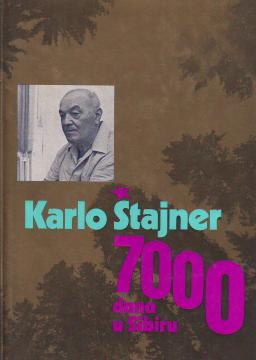
7000 dana u Sibiru
Ein rares Buch

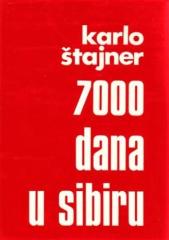
7000 dana u Sibiru

Karlo Štajner

Steiner spent twenty years in the most terrible camps in the expanses of Siberia, and in this book he presents the testimonies of the terrible crimes committed by Stalin in the name of communism.

7000 Days in Siberia is an autobiographical novel written by Karlo Steiner in 1971 and published by the publishing house Globus in Zagreb. In it, Steiner describes how, although he was a staunch communist, he became a victim of Stalin's Great Purge in 1936 when he was arrested in his apartment in Moscow and innocently sentenced to first ten, then twenty years in prison and work in the gulag on trumped-up charges that was a "Gestapo agent" because of his Austrian nationality. In the book, Steiner describes in detail the misery, misery and extreme cruelty of life in Soviet camps where prisoners were exploited in the most difficult physical jobs.

Steiner was transferred to several locations, from the Solovetsky Islands, through Norilsk and all the way to Maklakov in Siberia, but he survived thanks to his wife Sonja, who faithfully waited for him all that time until 1955, when they met again. After Stalin's death and de-Stalinization, Steiner was released and acquitted of all charges in 1956, after which he went back to Yugoslavia, to Zagreb, where he lived until his death. According to Steiner, the manuscript of the book has been waiting for years to be published, but it seems that some in Yugoslavia tried to prevent the publication: when he sent two copies of the novel to Zagreb and Belgrade, both disappeared. However, he finally waited for the book to be published when Tito personally approved it. Four years after its publication, the book was translated into German and French, while in 2004, a publishing house from Hong Kong published the book for the first time in Chinese, translated by Shi Chengtai.

4.6. In 1972, 7000 days in Siberia received the "Ivan Goran Kovačić" editor's award for the best book. Wolfgang Leonhard states that Steiner gave a detailed analysis of the Soviet economy, which only functioned thanks to the mass exploitation of millions of prisoners who worked practically for free for years. He also broke various taboos, among them the one that Stalin had both German and Austrian anti-fascists arrested and handed over to Hitler's Germany. He experienced the most difficult period during the Second World War, when the Soviet guards were particularly cruel, which reached its peak when 2.9. In 1942, about 400 prisoners were shot, which was called the "meat days". Miljenko Jergović says about the novel that "it is a perfect anthropological study, a novel about the twentieth century, a confirmation of the grandiose crime of communism, which disappears like a mirage as soon as the anti-communist jackals try to refer to it."

Editor
Leo Mates
Titelseite
Bronislav Fajon
Maße
24 x 17 cm
Seitenzahl
430
Verlag
Globus, Zagreb, 1982.
 
Latein Schrift. Fester Einband mit Schutzumschlag.
Sprache: Kroatisch.

Angeboten wird ein Exemplar

Zustand:Gebraucht, in ausgezeichnetem Zustand
Zum Warenkorb hinzugefügt!
 

Interessieren Sie sich für ein anderes Buch? Sie können das Angebot über unsere Suchmaschine suchen und finden oder Bücher nach Kategorien durchsuchen.

Diese Titel könnten Sie auch interessieren

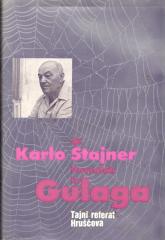
Povratak iz Gulaga: Tajni referat Hruščova

Povratak iz Gulaga: Tajni referat Hruščova

Karlo Štajner

Nastavak memoara 7000 dana u Sibiru, u kojima opisuje svoje dvadesetogodišnje zatočeništvo u sovjetskim gulazima. Knjiga produbljuje iskustva iz logora, donoseći dodatne uvide u Štajnerov život i refleksije o komunističkim idealima.

Globus, 1986.
Kroatisch. Latein Schrift. Fester Einband mit Schutzumschlag.
10,767,87 - 11,248,07
Ljubljana u borbi 1941–1945: Zbornik sećanja

Ljubljana u borbi 1941–1945: Zbornik sećanja

Die Sammlung vereint die Erinnerungen von Teilnehmern des nationalen Befreiungskampfes in Ljubljana während des Zweiten Weltkriegs. Die Sammlung enthält persönliche Zeugnisse, die Einblick in den Alltag, den Kampf und die Opfer der Einwohner Ljubljanas un

Vojnoizdavački zavod, 1978.
Serbisch. Latein Schrift. Fester Einband mit Schutzumschlag.
9,76
Lex Perković: Tajna udbaškog ubojstva

Lex Perković: Tajna udbaškog ubojstva

Večernjaks Sammlung politischer Dokumentarfilme

Večernji list, 2013.
Kroatisch. Latein Schrift. Taschenbuch.
1,95 - 1,98
Kroz tajni arhiv Udbe

Kroz tajni arhiv Udbe

Nikola Milovanović

Der Autor dieses Buches beschreibt das Schicksal der Hauptfeinde der jugoslawischen Kommunisten in der letzten Phase des Krieges sowie ihre Versuche, die Festigung der kommunistischen Macht in Jugoslawien in den ersten Nachkriegsjahren zu verhindern.

Sloboda, 1986.
Kroatisch. Latein Schrift. Fester Einband mit Schutzumschlag.
Das Buch besteht aus zwei Bänden
15,26
Zaraćeno poraće: Konfliktni i konkurentski narativi o stradanju i iseljavanju Talijana Istre

Zaraćeno poraće: Konfliktni i konkurentski narativi o stradanju i iseljavanju Talijana Istre

Franko Dota

Das Buch analysiert, wie sich nach dem Zweiten Weltkrieg (1943–1956) in Kroatien und Italien widersprüchliche historische Narrative über das Leid und die Massenauswanderung von Italienern aus Istrien und Rijeka entwickelten, entlarvt Mythen und fördert ei

Srednja Europa, 2010.
Kroatisch. Latein Schrift. Taschenbuch.
11,32
Živojin Pavlović: Između dogme i kritike

Živojin Pavlović: Između dogme i kritike

Slobodan Gavrilović

In terms of the number and content of facts, systematics, and method of interpretation, Gavrilović's work surpasses ordinary historiographical reading and stands side by side with the best literary creations about the events of one time and their actors.

Grafocard, 2001.
Serbisch. Kyrillisch Schrift. Taschenbuch.
9,58