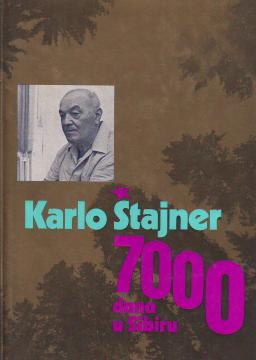
7000 dana u Sibiru
Retka knjiga

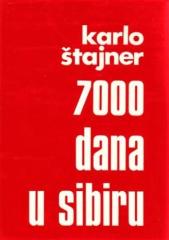
7000 dana u Sibiru

Karlo Štajner

Steiner spent twenty years in the most terrible camps in the expanses of Siberia, and in this book he presents the testimonies of the terrible crimes committed by Stalin in the name of communism.

7000 Days in Siberia is an autobiographical novel written by Karlo Steiner in 1971 and published by the publishing house Globus in Zagreb. In it, Steiner describes how, although he was a staunch communist, he became a victim of Stalin's Great Purge in 1936 when he was arrested in his apartment in Moscow and innocently sentenced to first ten, then twenty years in prison and work in the gulag on trumped-up charges that was a "Gestapo agent" because of his Austrian nationality. In the book, Steiner describes in detail the misery, misery and extreme cruelty of life in Soviet camps where prisoners were exploited in the most difficult physical jobs.

Steiner was transferred to several locations, from the Solovetsky Islands, through Norilsk and all the way to Maklakov in Siberia, but he survived thanks to his wife Sonja, who faithfully waited for him all that time until 1955, when they met again. After Stalin's death and de-Stalinization, Steiner was released and acquitted of all charges in 1956, after which he went back to Yugoslavia, to Zagreb, where he lived until his death. According to Steiner, the manuscript of the book has been waiting for years to be published, but it seems that some in Yugoslavia tried to prevent the publication: when he sent two copies of the novel to Zagreb and Belgrade, both disappeared. However, he finally waited for the book to be published when Tito personally approved it. Four years after its publication, the book was translated into German and French, while in 2004, a publishing house from Hong Kong published the book for the first time in Chinese, translated by Shi Chengtai.

4.6. In 1972, 7000 days in Siberia received the "Ivan Goran Kovačić" editor's award for the best book. Wolfgang Leonhard states that Steiner gave a detailed analysis of the Soviet economy, which only functioned thanks to the mass exploitation of millions of prisoners who worked practically for free for years. He also broke various taboos, among them the one that Stalin had both German and Austrian anti-fascists arrested and handed over to Hitler's Germany. He experienced the most difficult period during the Second World War, when the Soviet guards were particularly cruel, which reached its peak when 2.9. In 1942, about 400 prisoners were shot, which was called the "meat days". Miljenko Jergović says about the novel that "it is a perfect anthropological study, a novel about the twentieth century, a confirmation of the grandiose crime of communism, which disappears like a mirage as soon as the anti-communist jackals try to refer to it."

Urednik
Leo Mates
Naslovnica
Bronislav Fajon
Dimenzije
24 x 17 cm
Broj strana
430
Izdavač
Globus, Zagreb, 1982.
 
Latinica. Tvrde korice s omotom.
Jezik: Hrvatski.

Jedan primerak je u ponudi

Stanje:Korišćeno, u odličnom stanju
Dodato u korpu!
 

Zanima Vas i neka druga knjiga? Možete pretražiti našu ponudu pomoću pretrage ili prelistati knjige po kategorijama.

Možda će Vas zanimati i ovi naslovi

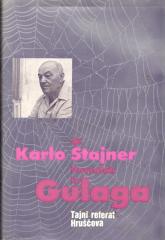
Povratak iz Gulaga: Tajni referat Hruščova

Povratak iz Gulaga: Tajni referat Hruščova

Karlo Štajner

Eine Fortsetzung seiner Memoiren „7000 Tage in Sibirien“, in denen er seine zwanzigjährige Gefangenschaft in sowjetischen Gulags beschreibt. Das Buch geht tief in seine Erfahrungen in den Lagern ein und bietet zusätzliche Einblicke in Steiners Leben und R

Globus, 1986.
Hrvatski. Latinica. Tvrde korice s omotom.
10,768,99 - 11,2410,76
Božja zemlja Nippon: Poučno o Japanu

Božja zemlja Nippon: Poučno o Japanu

Friedrich K. Haider, Slavko Pavičić

„God’s Land Nippon“ von Friedrich K. Haider und Slavko Pavičić ist ein Lehrbuch über Japan, seine Kultur, Geschichte, Bräuche und Spiritualität während des Zweiten Weltkriegs. Es diente der NDH als populäre Propagandalektüre.

Nakladna knjižara Velebit, 1942.
Hrvatski. Latinica. Broširano.
14,72
Hitler osvajač: raskrinkavanje jedne legende

Hitler osvajač: raskrinkavanje jedne legende

Rudolf Olden

Eines der ersten anti-Hitler-Werke, das bereits 1933 von Nolit veröffentlicht wurde. Dies ist eine frühe, kürzere Fassung des Werkes (ursprünglich anonym in Prag veröffentlicht), die der erweiterten Ausgabe aus Amsterdam von 1935 vorausging.

Nolit, 1933.
Hrvatski. Latinica. Tvrde korice s omotom.
15,32
Lex Perković: Tajna udbaškog ubojstva

Lex Perković: Tajna udbaškog ubojstva

Večernjaks Sammlung politischer Dokumentarfilme

Večernji list, 2013.
Hrvatski. Latinica. Broširano.
1,95 - 1,98
Sudbonosni podvig Jugoslavije: Podsjećanje na historijsko NE staljinizmu, događaj koji je opredijelio budućnost Jugoslavije

Sudbonosni podvig Jugoslavije: Podsjećanje na historijsko NE staljinizmu, događaj koji je opredijelio budućnost Jugoslavije

Raif Dizdarević

Das Buch von Raif Dizdarević, einem der letzten noch lebenden Akteure der jugoslawischen Diplomatie, präsentiert seine Rekonstruktion des schicksalhaftesten Moments im Nachkriegsjugoslawien – den Bruch mit Stalin und dem Informbüro in den Jahren 1948–1953

Udruženje za modernu historiju (UMHIS), 2018.
Hrvatski. Latinica. Broširano.
23,58
Doživljaji i putovanja do slobode

Doživljaji i putovanja do slobode

Vladimir Novak

Autobiografsko djelo hrvatskog komunističkog aktivista Vladimira Novaka, preživjelog iz ustaških logora, prati njegova sjećanja na otpor fašizmu tijekom Drugog svjetskog rata.

August Cesarec, 1979.
Hrvatski. Latinica. Tvrde korice s omotom.
8,26