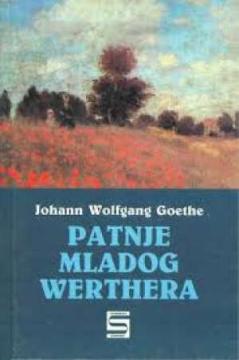
Patnje mladog Werthera

Patnje mladog Werthera

Johann Wolfgang Goethe

At one time, Mrs. de Staßl, who was extremely influential, said of Goethe's "Werther" that it was "a work that has killed more men than the most beautiful woman could."

Goethe's story about the love of a young man for his friend's fiancee and later his wife, with a tragic ending and all soaked in sentimentality, through which a protest against social discrimination also runs, resonated among contemporaries in different ways.

Germany, and very soon the entire cultural world that received translations, is suffocating in streams of tears, literature, painting, music are choked with the motifs of Werther, and the general public imitates Goethe's heroes in everything, and even in the way they dress. Men thus begin to wear in reality (like Werther in the novel) a blue riding coat with brass buttons, a yellow waistcoat and trousers, and high boots with brown edges.

This fashion came at that time from England, and was a kind of protest against the frivolity and stiffness of Rococo. As Goethe himself wore these clothes when he arrived in Weimar, the whole court began to dress like that, including Duke Karl August, who used to call other people Goethe's monkeys. The women of course followed Lotta's fashion line: a long white dress with a high waist, short sleeves and a plunging neckline, with bright red ribbons on it.

In the 19th century, the Croatian cultural audience received Goethe's works mainly in the original language, which explains the relatively late publication of the translation. So "Ladies of Young Werther" were first printed in 1931 in the translation of M. Cihlar Nehajev, but since then several editions with different translators have appeared.

Among them are I. V. Lalić, I. Hergešić, S. Slamnig, Vera Čičin-Šain, and the latest translation is by S. Mutak, published a few years ago.

Titel des Originals
Die Leiden des jungen Werthers
Übersetzung
Spomenka Mutak
Editor
Sandra Belčić
Titelseite
Boris Marjanović
Maße
20,5 x 14 cm
Seitenzahl
120
Verlag
Zagrebačka stvarnost, Zagreb, 2001.
 
Auflage: 3.000 Exemplare
 
Latein Schrift. Hardcover.
Sprache: Kroatisch.
ISBN
9-53-192059-1

Im Angebot sind keine Exemplare vorhanden

Das letzte Exemplar wurde kürzlich verkauft.
 

Interessieren Sie sich für ein anderes Buch? Sie können das Angebot über unsere Suchmaschine suchen und finden oder Bücher nach Kategorien durchsuchen.

Diese Titel könnten Sie auch interessieren

Jadi mladoga Vertera

Jadi mladoga Vertera

Johann Wolfgang Goethe
Rad, 1961.
Serbisch. Latein Schrift. Taschenbuch.
2,56
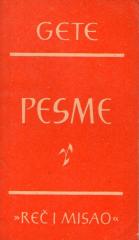
Pesme

Pesme

Johann Wolfgang Goethe
Izdavačko preduzeće "Rad", 1964.
Serbisch. Latein Schrift. Taschenbuch.
2,50 - 2,52
Egmont : tragedija u pet činova

Egmont : tragedija u pet činova

Johann Wolfgang Goethe
Matica hrvatska, 1942.
Kroatisch. Latein Schrift. Hardcover.
15,42
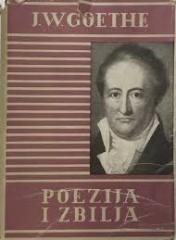
Poezija i zbilja

Poezija i zbilja

Johann Wolfgang Goethe

Goetheova najveća autobiografska proza, pisana između 1811. i 1833. godine, obuhvaća njegov život od rođenja 1749. u Frankfurtu do 1775., kada odlazi u Weimar na poziv vojvode Karla Augusta.

Matica hrvatska, 1953.
Kroatisch. Latein Schrift. Fester Einband mit Schutzumschlag.
18,42
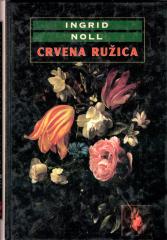
Crvena ružica

Crvena ružica

Ingrid Noll

A cult German "lady crime novel" and one of the biggest bestsellers of the 1990s in Germany, "The Red Rose" is the first book by Ingrid Noll, with which she became the founder of the "Hausfrauen-Thriller" genre.

Mozaik knjiga, 2000.
Kroatisch. Latein Schrift. Hardcover.
7,265,08
Izbor po srodnosti

Izbor po srodnosti

Johann Wolfgang Goethe

Roman prati bračni par Eduarda i Charlotte koji nakon godina razdvojenosti ponovo žive u harmoniji na svom imanju. Kada pozovu dva gosta da im se pridruže njihove se emocionalne veze počinju mijenjati.

Novo pokolenje, 1954.
Serbisch. Latein Schrift. Fester Einband mit Schutzumschlag.
8,96