Moskva – Petuški
Ein rares Buch

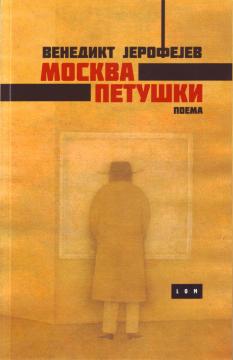
Moskva – Petuški

Venjedikt Jerofejev

Venedikt Yerofeyev's postmodern prose poem is today considered a classic of new Russian literature. It is compared to Gogol and Kharms for its poetics of absurdity, satire, and metaphysical depth.

Moscow – Petushki is a postmodern prose poem by Venedikt Yerofeyev (1938–1990), written in 1969–1970 in samizdat, published in Russia only in 1989 (during perestroika), and today it is considered a classic of new Russian literature and the last great Soviet myth. It is compared to Gogol and Kharms for its poetics of absurdity, satire, and metaphysical depth.

The story is pseudo-biographical: the lyrical hero Venichka (the author's alter ego) is a thirty-year-old alcoholic intellectual, fired from his job for drawing diagrams of how much workers drank. On Friday morning, he wakes up in an unfamiliar staircase in Moscow after several days of drunkenness, remembering nothing. He wants to go to Petushki (a real town 125 km east of Moscow) – an ideal, utopian space of love, where a “unique” lover and a three-year-old son (not necessarily his) await him. At Kursk Station, he buys alcohol and boards an electric train.

The journey is an alcoholic monologue: Venichka mixes incredible cocktails (“the tear of a kermesinka”, “the first kiss”, “the tears of a bitch”), talks with fellow travelers, angels, demons, God, quotes the Bible (the words of Christ, the New Testament, death and resurrection), Russian literature, the Soviet press, philosophizes about the Russian people (“we are all like drunks, but each in his own way: one laughs in the face of the world, the other cries on his chest”), ephemerality, paralysis of the soul, courage from an early age. Petushki becomes a metaphor for an unattainable paradise – the more he drinks, the more he loses his orientation.

In reality, Venichka never reaches Petushki: in a delirium, he returns to Moscow, where he is attacked by unknown people in passing and stabbed in the neck (the author later died of throat cancer in 1990). The novel is cyclical – it begins and ends in Moscow, without leaving the circle.

Through humor, irony, blasphemy, and lyricism, Yerofeyev criticizes Soviet reality: the absurdity of bureaucracy, the spiritual emptiness, where alcohol becomes the only way out of the “absolute rot of society.” Alcohol is the engine of the story and a symbol – from euphoria to tragedy. Quotes from the Bible, Gogol, Dostoevsky, Byron, and Soviet propaganda create a dense intertextuality.

Titel des Originals
Москва — Петушки
Übersetzung
Irena Lukšić
Editor
Flavio Rigonat
Maße
21 x 13,5 cm
Seitenzahl
173
Verlag
LOM, Beograd, 217.
 
Kyrillisch Schrift. Taschenbuch.
Sprache: Serbisch.

Angeboten wird ein Exemplar

Zustand:Gebraucht, in ausgezeichnetem Zustand
Zum Warenkorb hinzugefügt!
 

Interessieren Sie sich für ein anderes Buch? Sie können das Angebot über unsere Suchmaschine suchen und finden oder Bücher nach Kategorien durchsuchen.

Diese Titel könnten Sie auch interessieren

Pariški maraton : Knjiga pisanja (Pariz21. i 22. oktobar 2023)

Pariški maraton : Knjiga pisanja (Pariz21. i 22. oktobar 2023)

At the end of the eighties, Damir Uzunović traveled to Paris and stayed there for less than a year. He was twenty years old at the time, and that exile episode would be formative for the literature he would later write.

Buybook, 2024.
Kroatisch. Latein Schrift. Hardcover.
12,22
Pustolovine Toma Sawyera

Pustolovine Toma Sawyera

Mark Twain

The Adventures of Tom Sawyer is the first truly realistic children's novel, not only in American but also in world children's literature. Twain's most famous work and a favorite children's book in which the writer described his boyhood experiences.

Nakladni zavod Hrvatske, 1947.
Kroatisch. Latein Schrift. Hardcover.
16,32
Seks skandal 2: Političari u krevetu

Seks skandal 2: Političari u krevetu

Izabela D.

Nastavak ultimativnog hita Seks skandal: Ispovijedi zagrebačke manekenke, Seks skandal 2: Političari u krevetu, razotkriva moralno naličje hrvatskih političara koji javno glume nesebične borce za opće dobro, a privatno se prepuštaju požudama.

24 sata.
Kroatisch. Latein Schrift. Taschenbuch.
2,36
Rudnik čvaraka

Rudnik čvaraka

Tomislav Šovagović

Debitantsko djelo hrvatskog pisca Tomislava Šovagovića, nagrađeno nagradom Josip i Ivan Kozarac 2012., posveta je Slavoniji – regiji djetinjstva koju autor, rođen u Dalmaciji, promatra stranim, ali nježnim očima.

Mozaik knjiga, 20112.
Kroatisch. Latein Schrift. Taschenbuch.
11,56
I ne reče ni reči

I ne reče ni reči

Heinrich Böll

U Bollovim romanima jedna od središnjih tema je pokušaj da se očuvaju osnovne moralne vrijednosti u vrijeme terora, kao i u razdoblju materijalnog blagostanja i korupcije.

Svjetlost, 1965.
Serbisch. Latein Schrift. Taschenbuch.
3,22 - 3,98
Made in U.S.A.

Made in U.S.A.

Goran Tribuson

Zamislite Zagreb 1980-ih, gdje se iza sivih fasada blokova krije svijet snova o dalekom Zapadu – Hollywoodu, slobodi i beskrajnim mogućnostima. Tribuson, majstor hrvatske proze, ovdje spaja žanrove u jednu fluidnu priču koja te grize za dušu.

Znanje, 1986.
Kroatisch. Latein Schrift. Fester Einband mit Schutzumschlag.
5,72