Moskva – Petuški
Venedikt Yerofeyev's postmodern prose poem is today considered a classic of new Russian literature. It is compared to Gogol and Kharms for its poetics of absurdity, satire, and metaphysical depth.
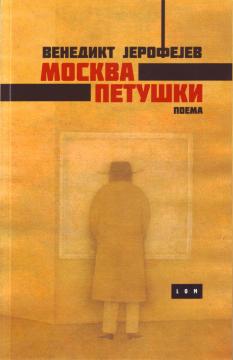
Moscow – Petushki is a postmodern prose poem by Venedikt Yerofeyev (1938–1990), written in 1969–1970 in samizdat, published in Russia only in 1989 (during perestroika), and today it is considered a classic of new Russian literature and the last great Soviet myth. It is compared to Gogol and Kharms for its poetics of absurdity, satire, and metaphysical depth.
The story is pseudo-biographical: the lyrical hero Venichka (the author's alter ego) is a thirty-year-old alcoholic intellectual, fired from his job for drawing diagrams of how much workers drank. On Friday morning, he wakes up in an unfamiliar staircase in Moscow after several days of drunkenness, remembering nothing. He wants to go to Petushki (a real town 125 km east of Moscow) – an ideal, utopian space of love, where a “unique” lover and a three-year-old son (not necessarily his) await him. At Kursk Station, he buys alcohol and boards an electric train.
The journey is an alcoholic monologue: Venichka mixes incredible cocktails (“the tear of a kermesinka”, “the first kiss”, “the tears of a bitch”), talks with fellow travelers, angels, demons, God, quotes the Bible (the words of Christ, the New Testament, death and resurrection), Russian literature, the Soviet press, philosophizes about the Russian people (“we are all like drunks, but each in his own way: one laughs in the face of the world, the other cries on his chest”), ephemerality, paralysis of the soul, courage from an early age. Petushki becomes a metaphor for an unattainable paradise – the more he drinks, the more he loses his orientation.
In reality, Venichka never reaches Petushki: in a delirium, he returns to Moscow, where he is attacked by unknown people in passing and stabbed in the neck (the author later died of throat cancer in 1990). The novel is cyclical – it begins and ends in Moscow, without leaving the circle.
Through humor, irony, blasphemy, and lyricism, Yerofeyev criticizes Soviet reality: the absurdity of bureaucracy, the spiritual emptiness, where alcohol becomes the only way out of the “absolute rot of society.” Alcohol is the engine of the story and a symbol – from euphoria to tragedy. Quotes from the Bible, Gogol, Dostoevsky, Byron, and Soviet propaganda create a dense intertextuality.
One copy is available