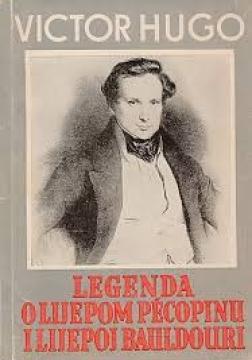
Legenda o lijepom Pécopinu i lijepoj Bauldouri

A romantic story by Victor Hugo, the 21st letter from his travelogue "Le Rhin" ("The Rhine", 1842). A romantic classic, similar to the fairy tales of the Brothers Grimm or Andersen, but with Hugo's deep emotionality and philosophy of eternal love.
The story takes place in medieval Germany, in a romantic, fairy-tale landscape along the Rhine. The handsome young knight Pecopin and the beautiful Bauldour have been in love with each other since childhood; their fathers have betrothed them. On their wedding day, Pecopin goes hunting for a huge boar that is terrorizing the village. In pursuit, the devil (in the form of a boar or a hunter) lures him into an enchanted forest, where time stops flowing normally: Pecopin hunts for centuries, goes through ages, wars and changes, but cannot return.
After 100 years, Pecopin finally returns – old, exhausted, but still in love. He finds Bauldour: she has waited faithfully, but has died of grief and old age. In the dramatic finale, love conquers death – Pecopin finds her in the grave, and the spirits are united in eternity.
Hugo uses folkloric motifs (the eternal hunt, the devil's illusion, the Rhine as a symbol of transience) to create a romantic fairy tale about love that transcends time, death, and fate. The story is lyrical, full of poetic descriptions of nature, medieval chivalry, and melancholy – typical of Hugo's style in "Le Rhin," where he mixes travelogue, history, and fiction.
One copy is available