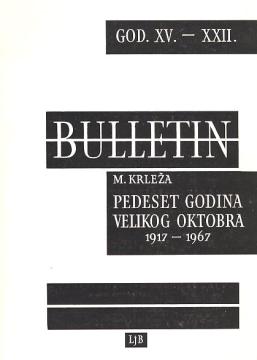
Bulletin - Pedeset godina Velikog oktobra 1917. - 1967.

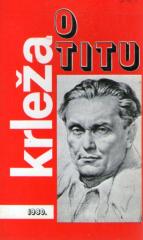
In “Fifty Years of the Great October 1917–1967,” Miroslav Krleža writes about the October Revolution from the perspective of a writer who is ideologically close to it, but who never agreed with its transformation into a system of rigid truths.
In this essay, Krleža starts from the fact that the 1917 Revolution did indeed open up space for unprecedented social change — it overthrew the old empire, gave voice to workers, peasants, and unprivileged intellectuals, and launched a global wave of hope for the possibility of a more just world.
However, Krleža does not accept this story as a dogma. His attitude towards October is ambivalent: he ideologically recognized the progressive power of the revolution, but he was equally irritated by every petrification of thought, every attempt to turn a political idea into an unquestionable truth. That is why the essay has a critical tone — the author recalls the repression, bureaucratization, and fear that eroded the original revolutionary ideal in later decades.
In a recognizable, dense style, he connects broad historical panoramas with personal observations, showing how ideas rise and then settle into forms that often contradict their own beginnings. Krleža does not celebrate October ritually; he sees it as a historical fact with a strong emancipatory potential, but also as an ideological matrix that, caught in its own patterns, often led astray.
The essay thus becomes a reflection of a writer who belongs to the left-wing ideological circle, but refuses to be its propaganda extension. For Krleža, October is both a promise and a warning — a moment in which history spoke on behalf of the weak, but also an example of how a great idea can lose its human face if it turns into a dogma.
One copy is available