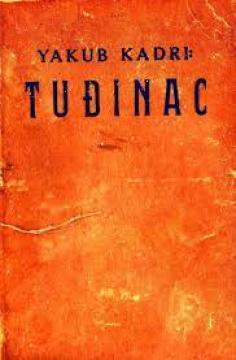
Tuđinac
The novel The Foreigner (Yaban, 1932) is a work by socially engaged writer Yakup Kadri Karaosmanoǧlu that speaks about the Turkish War of Independence and the instability of Turkish unity in 1918.
The novel is set during the time when the army led by Mustafa Kemal Pasha was trying to liberate Anatolia from foreign occupiers. The main character of the novel, Ahmet Celal, is a retired officer and war invalid who, disillusioned with the support of the Istanbul elite for the British occupiers and the Ottoman Sultan, moves to an Anatolian village. Seeing how conservative, uneducated, and like a pliable crowd the peasants are without their own ideals and views, Ahmet soon realizes that he will never be able to identify with them and becomes increasingly desperate because of their indifference to the national struggle and lack of patriotism.
In the eyes of the peasants, Ahmet is an alien, like other members of the educated elite like him. His ideals of a progressive, secular, and nationally conscious society are foreign and alien to the Anatolian peasants, which makes the protagonist increasingly distant from his own people. This alienation can best be seen at the very beginning of the novel, in which the author describes the area around Ankara after the liberation army's victory over the Greeks in the Battle of Sakarya, when a delegation finds a diary of an anonymous author while touring the battlefield. The members of the delegation ask the villagers to whom the diary belonged, and they reply that they do not know and that they do not care because this person was only a "foreigner" among them.
The suffering of the main character, manifested in conflicting emotions such as compassion, anger, sadness and unrequited love, is a reflection of the hopeless state of Turkish society at the time and a witness to the poor conditions in which the national forces fought against the occupiers. In order to further emphasize the "spiritual quagmire" in which the Republic found itself during the first ten years of its existence, the author describes nature as dirty and rotten, and attributes some kind of physical defect to almost every character.
Although it may seem that Karaosmanoǧlu directed his criticism only at the peasants, accusing them of credulity, superstition and lack of interest in the national struggle, with the novel Tuđinac he lashed out primarily at Turkish intellectuals, whom he sees as the main culprits for the neglected state of the country's peripheral regions due to the continued neglect of the countryside. The author concludes that major changes and true modernization will not occur unless the mentality of the Anatolian peasants changes, and new values such as the culture of reading and writing are not instilled in society.
With this novel, Karaosmanoğlu points to numerous divisions and dichotomies within the Turkish society of the early republican period, which are especially manifested in the misunderstanding between the educated and the uneducated, the urban elite and the Anatolian peasants, and the Western and traditional Muslim worldviews. The utopian ideas of reconciling Islam with the principles of a modern secular state, which some of the author's contemporaries cherished, seemed unattainable to Karaosmanoğlu's realpolitik beliefs, so he found the solution to the problem of the national, cultural and religious identity of the Turks in the Kemalist ideal of a secular nation.
One copy is available
- The cover is missing