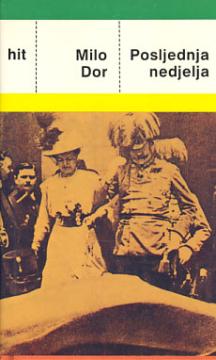
Posljednja nedjelja

Posljednja nedjelja

Milo Dor

The Last Sunday of Mila Dora is a historical novel about the Sarajevo assassination of 1914. Through the investigation of Judge Leo Pfeffer, it depicts the events that led to the assassination and the outbreak of World War I.

The Last Sunday is a novel by the Austrian writer of Serbian origin Mila Dora that deals with the last days before the Sarajevo assassination and the events that followed the assassination of Archduke Franz Ferdinand and his wife Sofia on June 28, 1914.

The central character of the novel is not the assassin Gavrilo Princip, but the investigating judge Leo Pfeffer, to whom the Austro-Hungarian authorities entrust the investigation. Through his work, the reader gets to know the main participants in the assassination – Gavrilo Princip, Nedeljko Čabrinović, Trifko Grabež and other members of the Young Bosnia organization. Pfeffer interrogates the assassins, tries to reconstruct their connections with Serbian nationalist circles and discover who organized the conspiracy.

The novel depicts in detail the atmosphere of Sarajevo on the eve of the assassination. The young conspirators live in modest conditions, discuss politics, national freedom and the future of Bosnia under Austro-Hungarian rule. At the same time, preparations for the arrival of Franz Ferdinand are shown, security lapses and a series of coincidences that will enable the assassination to succeed. Particularly impressive are the scenes after Čabrinović's failed attempt with a bomb and Princip's subsequent encounter with the Archduke's car, which almost accidentally stops right in front of him.

Through Pfeffer's investigation, the novel gradually shifts from a chronicle of the assassination to an analysis of political relations in Europe just before the war. The judge discovers that a single act of violence has much wider consequences than the assassins could have imagined. In the background, one can feel the growing tensions between the great powers that will soon lead to World War I.

Milo Dor combines documentary facts and literary fiction to create a convincing account of one of the most important events of the 20th century. The Last Sunday is at once a historical novel, a political analysis and a story about people whose decisions changed the course of European history.

Original title
Der letzte Sonntag
Translation
Anka Katušić Balen
Editor
Zlatko Crnković
Graphics design
Alfred Pal
Dimensions
19.5 x 12 cm
Pages
235
Publisher
Znanje, Zagreb, 1985.
 
Distribution: 6,000 copies
 
Latin alphabet. Hardcover with dust jacket.
Language: Croatian.

One copy is available

Condition:Used, excellent condition
Damages or inconvenience notice:
  • Traces of patina
 

Are you interested in another book? You can search the offer using our search engine or browse books by category.

You may also be interested in these titles

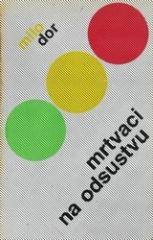
Mrtvaci na odsustvu

Mrtvaci na odsustvu

Milo Dor
Književna zajednica Novog Sada, 1987.
Serbian. Latin alphabet. Paperback.
5.99
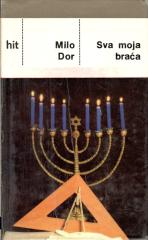
Sva moja braća

Sva moja braća

Milo Dor

Das Buch verfolgt das turbulente Leben der Brüder Zanović aus Budva im 18. Jahrhundert, die für ihre Abenteuer an europäischen Höfen berühmt waren. Im Mittelpunkt steht Stjepan Zanović, eine charismatische, aber umstrittene Persönlichkeit, Freimaurer und

Znanje, 1987.
Croatian. Latin alphabet. Hardcover with dust jacket.
4.28
Djeca jedne zime

Djeca jedne zime

Dea Trier Morch

Ein dokumentarischer Roman, der die Erlebnisse von Frauen in der Entbindungsstation des Kopenhagener Stadtkrankenhauses über einen Monat hinweg verfolgt. Der Roman in Form eines Tagebucheintrags begleitet die Schwangerschaft und Geburt von sechs Frauen in

Globus, 1987.
Croatian. Latin alphabet. Hardcover with dust jacket.
4.52 - 5.62
Ranjeni pejzaž

Ranjeni pejzaž

Vladimir Mičetić

Knjiga Vladimira Mičetića, lekara i dobrovoljca Domovinskog rata iz Kutine. Delo je nagrađeno književnom nagradom „Bili smo prvi kada je trebalo“ za 2010. godinu, koju dodeljuje Udruženje hrvatskih boraca Domovinskog rata.

Spiritus Movens, 2010.
Croatian. Latin alphabet. Hardcover.
11.52
Zaboravite da ste imali kćer

Zaboravite da ste imali kćer

Sandra Gregory, Michael Tierney

Sandra Gregori je živela život u Bangkoku o kakvom se moglo samo sanjati sve dok je bolest, nezaposlenost i politički nemiri nisu pretvorili u noćnu moru.

Marjan tisak, 2003.
Croatian. Latin alphabet. Paperback.
7.82 - 7.98
Dinamit: Povijest klasnog nasilja u Americi

Dinamit: Povijest klasnog nasilja u Americi

Louis Adamić

Knjiga dokumentuje vek nasilja u američkom radničkom pokretu — od štrajkova u rudarstvu u 19. veku do bombardovanja i sukoba sa policijom — i otkriva brutalnu pozadinu američkog „klasnog rata“.

Naklada Binoza, 1933.
Croatian. Latin alphabet. Hardcover with dust jacket.
7.24