
Cvjetovi zla

Cvjetovi zla

Charles Baudelaire

The Flowers of Evil is a collection of poetry by Charles Baudelaire that includes almost all of his poetry, written from 1840 until his death. First published in 1857, it was important in the Symbolist and Modernist movements. The book comes with a gramop

Though it was extremely controversial upon publication, with six of its poems censored due to their immorality, it is now considered a major work of French poetry. The poems in Les Fleurs du mal frequently break with tradition, using suggestive images and unusual forms. They deal with themes relating to decadence and eroticism, particularly focusing on suffering and its relationship to original sin, disgust toward evil and oneself, obsession with death, and aspiration toward an ideal world. Les Fleurs du mal had a powerful influence on several notable French poets, including Paul Verlaine, Arthur Rimbaud, and Stéphane Mallarmé.

Original title
Les Fleurs du mal
Translation
Ante Jurjević, Vladislav Kušan, Dunja Robić, Tin Ujević
Editor
Vlatko Pavletić
Graphics design
Boris Dogan
Dimensions
19 x 19 cm
Pages
374
Publisher
Matica hrvatska, Zagreb, 1971.
 
Latin alphabet. Hardcover with dust jacket.
Language: Croatian.

No copies available

The last copy was sold recently.
 

Are you interested in another book? You can search the offer using our search engine or browse books by category.

You may also be interested in these titles

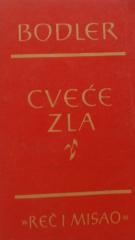
Cveće zla

Cveće zla

Charles Baudelaire
Izdavačko preduzeće "Rad", 1964.
Serbian. Latin alphabet. Paperback.
2.50
Prijatelj Armenac

Prijatelj Armenac

Andreï Makine
Disput, 2023.
Croatian. Latin alphabet. Paperback.
11.26
Morski orao

Morski orao

Eduard Peisson

Édouard Peisson, a French writer specializing in maritime novels, brings a story set in the world of the sea and ships in this work, which is typical of his oeuvre.

Svjetlost, 1964.
Croatian. Latin alphabet. Paperback.
2.64
Dječak iz pećine

Dječak iz pećine

Ernest D'hervilly

The book "Cave Boy" deals with the topic of prehistoric life, showing the adventures and challenges faced by the young protagonist in a cave environment.

Narodna prosvjeta, 1959.
Croatian. Latin alphabet. Hardcover.
4.22
Eugenija Grande

Eugenija Grande

Honore de Balzac

"Eugénie Grandet" (1833), part of Balzac's Human Comedy, is a realistic novel that explores greed, family relationships, and the sacrifices of love in provincial French society.

Svjetlost, 1981.
Croatian. Latin alphabet. Hardcover.
3.88
Čovek od gipsa

Čovek od gipsa

Joseph Kessel

The novel, whose original title is L'Homme de plâtre, explores complex human destinies through the story of a protagonist whose life symbolically reflects fragility and vulnerability, like plaster.

Minerva, 1987.
Serbian. Latin alphabet. Hardcover.
4.64