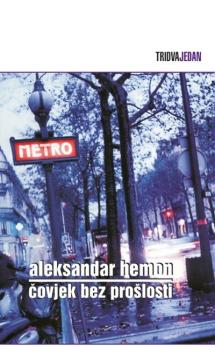
Čovjek bez prošlosti

Čovjek bez prošlosti

Aleksandar Hemon

The most convincing part of this novel is certainly the one in Sarajevo, but also in other parts of the novel, Aleksandar Hemon connects interesting motives and observations in a breakneck fashion into a unique novel construction.

At the same time, this autobiographical mystification in which Hemon narrates the life of his alter ego Jozef Pronek is thematically based to a large extent on Sarajevo, Bosnia and SFR Yugoslavia, and Yugoslavia from those times when it was not yet interesting to CNN.

Pronek's biography is told in the first person by his friends and/or eyewitnesses, and three separate parts can be distinguished. In the first, the narrator narrates about Pronek growing up in Sarajevo in the eighties, in the second, Pronek as a member of the Ukrainian minority finds himself on a scholarship in Kiev during the anti-democratic coup in Moscow, and in the third, Pronek is an immigrant to the USA who collects donations from house to house for Greenpeace. The novel ends with a Borgesian novel about the Russian "white" officer Yevgeni Pick and his adventures in Harbin and Shanghai at the beginning of the century.

Original title
Nowhere man
Translation
Luka Bekavac
Editor
Nenad Rizvanović
Dimensions
20 x 12 cm
Pages
255
Publisher
VBZ, Zagreb, 2004.
 
Latin alphabet. Paperback.
Language: Croatian.
ISBN
9-53-201377-6

One copy is available

Condition:Used, excellent condition
 

Are you interested in another book? You can search the offer using our search engine or browse books by category.

You may also be interested in these titles

Moskva – Petuški

Moskva – Petuški

Venjedikt Jerofejev

Venedikt Yerofeyev's postmodern prose poem is today considered a classic of new Russian literature. It is compared to Gogol and Kharms for its poetics of absurdity, satire, and metaphysical depth.

LOM, 217.
Serbian. Cyrillic alphabet. Paperback.
11.24
Kuća na obali

Kuća na obali

Daphne Du Maurier

Du Maurier masterfully blends sci-fi, the gothic atmosphere of Cornwall, and psychological drama – about addiction, escape from reality, identity, and the value of nostalgia. A tense and introspective novel, with an emphasis on how the past can be more da

Nakladni zavod Matice hrvatske, 1977.
Croatian. Latin alphabet. Hardcover with dust jacket.
5.36
Svjetlost se ugasila

Svjetlost se ugasila

Rudyard Kipling

The first novel by English Nobel Prize winner Rudyard Kipling (1865–1936), first published in Lippincott's Monthly Magazine (happy ending variant), and then in a book version with a tragic ending.

Zora, 1957.
Croatian. Latin alphabet. Hardcover with dust jacket.
5.42
O čemu ne govorimo

O čemu ne govorimo

Slavenka Drakulić

Can you face the taboos of modern society? Old age, illness, weakness. Slavenka Drakulić bravely enters into topics we are reluctant to talk about.

Fraktura, 2024.
Croatian. Latin alphabet. Hardcover with dust jacket.
14.62
Pažnja

Pažnja

Alberto Moravia

Francesco Merighi returns to Rome after 9 years abroad. In order to write an "authentic" novel, he keeps a diary of his life with his wife and their daughter Babe. He obsessively analyzes lies in relationships, the temptation of

Otokar Keršovani, 1966.
Croatian. Latin alphabet. Hardcover.
3.96
Život je negdje drugdje

Život je negdje drugdje

Milan Kundera

Jaromil, a young poet raised by a possessive mother, seeks a "real life" in poetry and revolution. His lyrical youth, love, and idealism lead him into conformity and betrayal of intimate relationships – he dies young and unfulfilled.

Znanje, 1979.
Croatian. Latin alphabet. Hardcover with dust jacket.
4.86