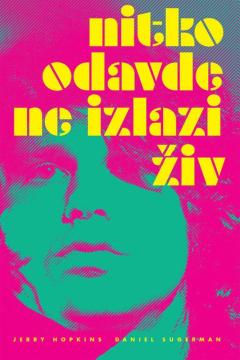
Nitko odavde ne izlazi živ

Nitko odavde ne izlazi živ

Jerry Hopkins, Daniel Sugerman

The cult biography of The Doors' singer Jim Morrison, No One Here Gets Out Alive, written in the spirit of the era, without a hair on the tongue, is a must-read for all admirers of this true great of rock music.

Jim Morrison was a man who neither wanted nor could agree to compromises, a man who refused them, either in relation to himself or his art. And therein lies his innocence and purity – his simultaneous blessing and curse. Go all the way or die trying. All or nothing. Ecstatic risk. He did not want to create ready-made goods or lower the price of what he wrote, he could not feign despair or simulate ecstasy. He didn't just want to entertain or “work out; he was brilliant and desperate, motivated by a constant need to test the limits of reality", questioning the sacred, exploring the profane. And that's why he was crazy... crazy about creativity, crazy about authenticity. But because of the same traits, he became unstable, dangerous and conflicted with himself. He sought solace and relief in the same elements that initially inspired him and helped him create: opiates.

Jim Morrison's poems reflect the influence of William Blake, Charles Baudelaire, Arthur Rimbaud and Friedrich Nietzsche. Remembered for his theatrical, Dionysian, provocative and even obscene stage performances - there were often more policemen on stage than band members - Morrison looked for inspiration in the work of the French playwright Antonin Artaud and in the shamanism of American Indians. Genuinely interested in mythology, mysticism and symbolism, he read Frazer's The Golden Bough, and the name of the group The Doors, of which he was the singer, was derived from the title of Aldous Huxley's essay, The Doors of Perception. Trying to get through them himself, he did not hesitate to consume huge amounts of alcohol and hallucinogenic drugs, so that in the end he succeeded: he broke through to the "other side" as a twenty-seven-year-old (The gate is straight / Deep and wide / Break on through to the other side...). He was buried in Paris, at the Pere-Lachaise cemetery, and his company includes Marcel Proust, Frederic Chopin, Oscar Wilde, Édith Piaf...

Original title
No One Here Gets Out Alive
Translation
Karmela Cindrić
Editor
Darko Milošić
Graphics design
Nikša Eršek
Dimensions
23.5 x 16 cm
Pages
327
Publisher
Sandorf, Zagreb, 2020.
 
Latin alphabet. Paperback.
Language: Croatian.
ISBN
978-9-53351-205-1

No copies available

The last copy was sold recently.

 

Are you interested in another book? You can search the offer using our search engine or browse books by category.

You may also be interested in these titles

Moje uspomene (1900. – 1976.)

Moje uspomene (1900. – 1976.)

Božo Milanović

The book is an autobiographical work by the priest, intellectual and national fighter for the rights of Croats in Istria, Monsignor Božo Milanović.

Kršćanska sadašnjost, 1976.
Croatian. Latin alphabet. Hardcover with dust jacket.
8.62
Marija Terezija

Marija Terezija

Karl Tschuppik

A biography of the Habsburg Empress Maria Theresa, one of the most influential rulers of the 18th century. Tschuppik, an Austrian historian and journalist, provides a vivid portrait of her life and reign, combining historical facts with a narrative style.

Binoza, 1936.
Croatian. Latin alphabet. Hardcover.
8.32
Der König des Kung Fu: Bruce Lee - sein Leben und Kampf

Der König des Kung Fu: Bruce Lee - sein Leben und Kampf

The book presents an intimate and authentic biography of this martial arts legend and film icon. Linda Lee provides personal insight into her husband's life, philosophy, and legacy, giving the book emotional depth and authenticity.

Falken Verlag, 1976.
German. Latin alphabet. Paperback.
9.56
Karl Marx: Čovjek preinake svijeta

Karl Marx: Čovjek preinake svijeta

Davor Kačar, Boris Jurinić

Karl Marx - The Man Who Changed the World (1983) by Davor Kačar and Boris Jurinić is a study of the life and work of Karl Marx. It explores his philosophy, economic theory, and influence on world history through Marxism, with illustrations and documents.

Svjetlost, 1983.
Croatian. Latin alphabet. Hardcover with dust jacket.
12.24
Bibliografija, izabrani tekstovi

Bibliografija, izabrani tekstovi

Oto Švajcer

The book presents Švajcer's entire bibliography and a selection of his published and unpublished texts (e.g. texts on Krunoslav Kern; Branko Kovačević; Osijek painting between the two wars; Antun Babić as a graphic artist, etc.).

Galerija likovnih umjetnosti, 1995.
Croatian. Latin alphabet. Paperback.
7.32 - 7.36
Život i djelo dr. Ante Starčevića : oca hrvatske domovine

Život i djelo dr. Ante Starčevića : oca hrvatske domovine

Stjepan Sršan

The book presents a comprehensive study of the life and legacy of Ante Starčević (1823–1896), known as the "Father of the Homeland", founder of the Party of Rights and a key figure in the Croatian national revival.

Državni arhiv u Osijeku, 2006.
Croatian. Latin alphabet. Paperback.
2.98