Contemporary philosophy • Philosophy of law
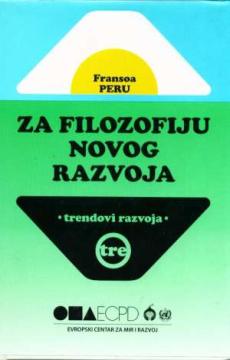
Za filozofiju novog razvoja
Francois Perroux
For the philosophy of new development, the author François Peru represents an important work that deals with the economic and social aspects of development.
This book explores the concepts of growth, development and progression, and offers theoretical elaborations on the economic independence of nations, inflation, capitalism and other relevant concepts.
An essay novel by Dutch psychologist Douwe Draaisme, a follow-up to his hit Why Life Speeds Up as We Get Older. The author combines neuroscience, philosophy, and literature to debunk myths about brain aging.
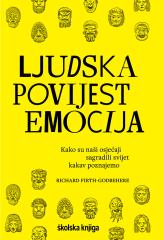
In this provocative and interdisciplinary book, the author shows that emotions are not universal biological constants, but change across time, cultures, and social contexts – and they are precisely those that are crucial in shaping the history of humanity
Školska knjiga, 2023.
Croatian. Latin alphabet. Hardcover with dust jacket.
The book Farewell to Modernity is a collection of philosophical essays in which Danilo Pejović reflects on the crisis of the modern era and its fundamental ideas.
Matica hrvatska, 1993.
Croatian. Latin alphabet. Paperback.
6.98 €
Political philosophy • Contemporary philosophy • Autobiographies and Memoirs • Interviews
A book of interviews in which Kołakowski retrospectively describes his life and intellectual journey through the turbulent 20th century – from pre-war Poland, through Nazi occupation, Stalinism, revisionist Marxism, to exile in the West.
Službeni glasnik, 2009.
Serbian. Cyrillic alphabet. Paperback.
The book consists of two volumes
19.44 €
Political philosophy • Contemporary philosophy • Collections and chronologies
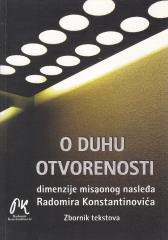
The collection is an important contribution to the revitalization of Konstantinović's thought in the post-Yugoslav space, demonstrating that his critique of the rural mind remains relevant for understanding contemporary social and political pathologies.
Deleuze's Portrait of Foucault (1986) is not a monograph, but a creative "thinking with Foucault." It analyzes the archaeology of knowledge, introducing the concepts of archive, power, subjectification, and "fold" as crucial to Foucault's thought on knowl