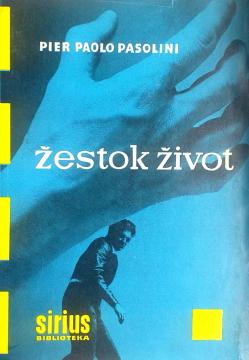
Žestok život

Žestok život

Pier Paolo Pasolini

The novel follows the life of Tommaso Puzzilli, a young man from the suburbs of Rome, in post-war Italy. The novel explores themes of violence, class struggle, sexuality and the search for identity through a raw, realistic depiction of working-class life.

Tommaso, a young delinquent, lives in a world of street gangs, petty crime, and moral dilemmas. His life is filled with conflicts—with society, his family, and himself. Pasolini portrays him as a complex character who oscillates between brutality and vulnerability, despair, and a desire for redemption. Through Tommaso’s relationships, including his love affair with Irene and his friendships with characters like Lello, the novel reveals a deep humanity within a harsh environment.

Pasolini’s style mixes neorealism with poetry, using Roman dialect to evoke the authenticity of the suburbs. The novel criticizes capitalist society and its indifference to the marginalized, while simultaneously exploring political tensions, including Tommaso’s brief flirtation with communism. The tragic ending, marked by illness and death, emphasizes the impossibility of escaping the cycle of poverty and violence.

Fierce Life is a powerful fresco of social injustice and human struggle, based on Pasolini’s fascination with authenticity and resistance to conformity.

Original title
Una vita violenta
Translation
Dušanka Orlandi
Editor
Oto Šolc
Graphics design
Milan Vulpe
Dimensions
20 x 13.5 cm
Pages
279
Publisher
Mladost, Zagreb, 1962.
 
Latin alphabet. Hardcover with dust jacket.
Language: Croatian.

No copies available

The last copy was sold recently.
 

Are you interested in another book? You can search the offer using our search engine or browse books by category.

You may also be interested in these titles

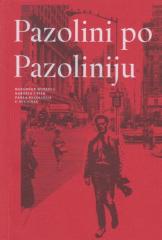
Pazolini po Pazoliniju: razgovor Đuzepea Kardila i Pjer Paola Pazolinija u Njujorku

Pazolini po Pazoliniju: razgovor Đuzepea Kardila i Pjer Paola Pazolinija u Njujorku

Pier Paolo Pasolini, Giuseppe Cardillo

In one of the last interviews, from 1969, Giuseppe Cardillo talks to Pier Paolo Pasolini, director of cult films such as Salo or 120 days of Sodom and Decameron, writer, poet and one of the most important intellectuals of Italy in the 20th century

Multimedijalni institut, 2023.
Serbian. Latin alphabet. Paperback.
7.54
Ivanhoe

Ivanhoe

Walter Scott
August Cesarec, 1991.
Croatian. Latin alphabet. Paperback.
4.99
Kurlani: Gornji i Donji

Kurlani: Gornji i Donji

Mirko Božić

A post-war novel, the so-called native prose, published in 1952, a revised version dates from 1956, the first part of the "Kurlan trilogy" (followed by "Neisplakani", 1955 and "Tijela i duhovi", 1981) by the Croatian playwright, short story writer and nov

Večernji list, 2004.
Croatian. Latin alphabet. Hardcover with dust jacket.
2.48 - 2.76
Carev glasnik

Carev glasnik

Jules Verne
Tehnička knjiga, 1952.
Serbian. Latin alphabet. Paperback.
The book consists of two volumes
5.64
Volim sutra

Volim sutra

Faiza Guene

"I Love Tomorrow" is a semi-autobiographical novel-diary, a snippet from the life of Doria, a lively, witty, sharp and somewhat sassy fifteen-year-old who is slowly learning to look at the world positively.

Sys Print, 2006.
Croatian. Latin alphabet. Paperback.
9.986.99
Čitačica pjesama

Čitačica pjesama

Lisa Tucker
Algoritam, 2004.
Croatian. Latin alphabet. Paperback.
3.65