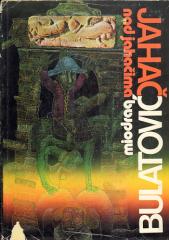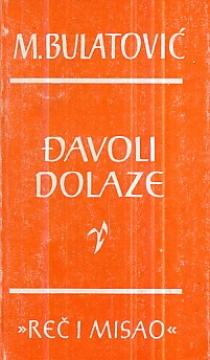
Đavoli dolaze

Đavoli dolaze

Miodrag Bulatović

In Miodrag Bulatović's novel The Devils Are Coming, grotesque and phantasmagoria meet the reality of a Balkan village. Through symbolism, irony and dark humor, the author depicts moral decay, madness and evil that arises among people, not outside of them.

Devils Are Coming is one of the most memorable novels by Miodrag Bulatović, published in the early 1950s, which established the author as an exceptionally original voice of modern Serbian and Montenegrin literature. The novel is an allegorical, grotesque and psychologically complex work in which reality and phantasmagoria constantly intertwine, creating the atmosphere of a hallucinatory, almost apocalyptic world.

The plot is set in a Balkan village devastated by war and poverty, where, on the eve of great historical and spiritual upheavals, “devils” appear – not as supernatural beings, but as symbols of human depravity, fear and madness. Through a series of characters who lose touch with reason, Bulatović shows how moral boundaries are erased in times of evil, and how everyone carries their own share of darkness within themselves.

The style of the novel is marked by poetic tension, expressionistic images, bold metaphors and black humor. Bulatović's language pulsates between visionary lyricism and brutal realism, creating a unique artistic blend that unsettles and enchants the reader.

Thematically, the novel examines the boundary between good and evil, madness and reason, creating a panorama of a world in which "devils" are no longer demons from legends, but people who have lost faith, meaning and humanity. The Devils Are Coming remains one of the key works of modernist prose and a symbol of Bulatović's obsessive theme - the tragic, but also grotesque nature of man.

Editor
Branislav Milošević
Graphics design
Janko Krajšek
Dimensions
18 x 10.5 cm
Pages
249
Publisher
Rad, Beograd, 1986.
 
Distribution: 10,000 copies
 
Latin alphabet. Paperback.
Language: Serbian.
ISBN
8-60-900021-4

One copy is available

Condition:Used, excellent condition
 

Are you interested in another book? You can search the offer using our search engine or browse books by category.

You may also be interested in these titles

Jahač nad jahačima

Jahač nad jahačima

Miodrag Bulatović

A novel about the absurd, power and downfall of a man obsessed with greatness. In a symbolic, grotesque world, the author exposes the cruelty of power and madness in which ambition and fear blur the line between man and beast.

Partizanska knjiga, 1980.
Serbian. Latin alphabet. Hardcover with dust jacket.
9.99
Gullo Gullo

Gullo Gullo

Miodrag Bulatović

Gullo Gullo is a grotesquely powerful novel about the moral and spiritual decay of a human being. In a world of violence, fear and absurdity, the main character wanders between life and death, good and evil, in search of meaning in a tragically twisted re

Prosveta, 1983.
Serbian. Latin alphabet. Hardcover with dust jacket.
2.82
Rat je bio bolji

Rat je bio bolji

Miodrag Bulatović

Conceived and realized as a separate entity, this novel can also be interpreted as the second part of the book "The Hero on the Donkey." To a greater extent than in "The Hero," here the war "which was better" is depicted as a gigantic burlesque and a pool

Prosveta, 1983.
Serbian. Latin alphabet. Hardcover with dust jacket.
2.99
Deobe

Deobe

Dobrica Ćosić

Deobe is a novel about the tragic division of Serbs into Chetniks and Partisans during World War II. Winner of the NIN Award, it is part of a wider epic trilogy, inspired by Ćosić's experiences and historical documents.

Prosveta, 1963.
Croatian. Latin alphabet. Hardcover with dust jacket.
13.74
Proces

Proces

Franz Kafka

Kafka wrote The Process between 1914 and 1915, published posthumously in 1925. The novel is unfinished but with an added final chapter by Max Brod. Edition with a foreword by B. Živojinović and an afterword by Walter Killi.

BIGZ, 1990.
Serbian. Latin alphabet. Paperback.
4.26
Usta puna zemlje

Usta puna zemlje

Branimir Šćepanović

The novel "Usta puna zemlje" (1970), the masterpiece of the Serbian writer Branimir Šćepanović, is a psychologically in-depth explorer of the limits of the human soul, solitude and existential freedom, reminiscent of Kafka and Camus.

BIGZ, 1987.
Serbian. Latin alphabet. Paperback.
3.98