Kritika rasudne snage
Rare book

Kritika rasudne snage

Immanuel Kant
Kant

Kant explores the nature of beauty, the sublime, and purposiveness in nature, linking aesthetics to human cognition and morality. A foundational work of modern aesthetics and the philosophy of art.

The Critique of Judgment (1790) is the third major critical work by Immanuel Kant, following the Critique of Pure Reason and the Critique of Practical Reason. In it, the German philosopher explores aesthetic judgment, beauty, the sublime, and the purposiveness of nature, seeking to bridge the realms of natural necessity and human freedom.

The work is divided into two main parts: the Critique of Aesthetic Judgment and the Critique of Teleological Judgment.

In the first part, Kant examines the nature of aesthetic experience and the question of how a judgment of beauty—despite being grounded in a subjective feeling of pleasure—can claim universal agreement. He distinguishes between the beautiful and the sublime, investigates the relationship between art and nature, and develops the concepts of genius, taste, and disinterested liking.

The second part is devoted to judging nature as a purposively organized whole. Kant focuses particularly on living organisms, whose complex structure and the interconnection of their parts cannot be understood simply through the model of mechanical causation. In doing so, he distinguishes purposiveness as a principle of our judgment from the claim that nature objectively operates according to a predetermined intention.

The Critique of Judgment has had a decisive influence on the development of modern aesthetics, the philosophy of art, German idealism, and the philosophy of nature. The work raises fundamental questions regarding the relationship between beauty, knowledge, freedom, and the human understanding of the world.

Original title
Kritik der Urteilskraft
Translation
Viktor D. Sonnenfeld
Editor
Marijan Tkalčić
Graphics design
Zoltan Gabor
Dimensions
20 x 14 cm
Pages
350
Publisher
Kultura, Zagreb, 1957.
 
Latin alphabet. Hardcover with dust jacket.
Language: Croatian.

One copy is available

Condition:Used, excellent condition
 

Are you interested in another book? You can search the offer using our search engine or browse books by category.

You may also be interested in these titles

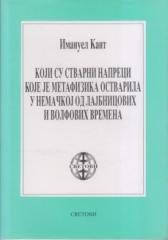
Koji su stvarni napreci koje je metafizika ostvarila u Nemačkoj od Lajbnicovih i Volfovih vremena

Koji su stvarni napreci koje je metafizika ostvarila u Nemačkoj od Lajbnicovih i Volfovih vremena

Kant
Immanuel Kant

Kant re-examines the development of German metaphysics from Leibniz and Wolff to critical philosophy, exploring the limits of human reason and the possibility of reliable metaphysical knowledge.

Svetovi, 2004.
Serbian. Cyrillic alphabet. Paperback.
9.99 €
Religija unutar granica čistog uma

Religija unutar granica čistog uma

Kant
Immanuel Kant

Kant explores the relationship between religion, morality and human reason, questioning the nature of evil, freedom of will and the meaning of faith. A key work on the possibility of a religion based on ethics and rational thought.

BIGZ, 1990.
Serbian. Latin alphabet. Hardcover with dust jacket.
16.24 €
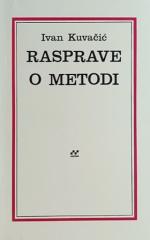
Rasprave o metodi

Rasprave o metodi

Ivan Kuvačić

"Discourses on Method" is a collection of essays and discussions by the prominent Croatian sociologist Ivan Kuvačić (1924–2005), written during his many years of work at the Department of Sociology at the Faculty of Philosophy in Zagreb.

Naprijed, 1988.
Croatian. Latin alphabet. Paperback.
6.744.72 €
Dijalektički smisao naglih i skokovitih promena - primena u nauci

Dijalektički smisao naglih i skokovitih promena - primena u nauci

The book "Dialectical meaning of sudden and sudden changes - application in science" explores how dialectical methods can be applied to scientific changes and progress.

Centar za marksizam, 1984.
Serbian. Latin alphabet. Paperback.
7.38 €