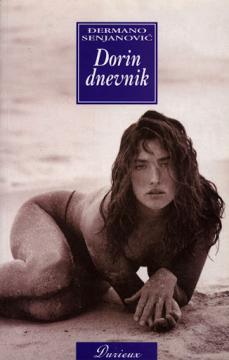
Dorin dnevnik

Dorin dnevnik

Đermano Senjanović

Dora's diary is prose of national significance, because Đerman Senjanović's texts skillfully depict our national and social everyday life, extremely spiritually distorted to the point of absurdity.

"Dora is a devoted wife and self-sacrificing mother of two children, a responsible clerk and a hard-working housewife to her family, and if this text had the intention of being instructive for any reason, then they would have realized that it might be about your and our first or any (city ) neighbors, into whose diary and head we have the opportunity to look thanks to the mediator Đerman Senjanović and the Durieux publishing house from Zagreb, which published the long-awaited Dora's Diary (1492-1996) at the beginning of April. In the middle are texts, namely, which Senjanović has been publishing regularly, from issue to issue, on the penultimate page of the Split weekly Feral Tribune for several years. And reading, which in that period represents certainly the best domestic prose, no matter how much such a statement irritates some, but often Croatian literary men who cannot imagine significant literature without the preceding and accompanying academic reality and arrogance ... Dora's diary is actually a surrealistically numbered inventory of controlled madness - her own, but clearly caused almost exclusively by external circumstances." (Free Dalmatia)

Editor
Nenad Popović
Dimensions
20 x 13 cm
Pages
335
Publisher
Durieux, Zagreb, 1997.
 
Latin alphabet. Paperback.
Language: Croatian.

No copies available

The last copy was sold recently.
 

Are you interested in another book? You can search the offer using our search engine or browse books by category.

You may also be interested in these titles

Moskva – Petuški

Moskva – Petuški

Venjedikt Jerofejev

Venedikt Yerofeyev's postmodern prose poem is today considered a classic of new Russian literature. It is compared to Gogol and Kharms for its poetics of absurdity, satire, and metaphysical depth.

LOM, 217.
Serbian. Cyrillic alphabet. Paperback.
11.24
Što je muškarac bez brkova: humoristički roman

Što je muškarac bez brkova: humoristički roman

Ante Tomić

When it was first published in 2000, Tomić's novel What is a Man Without a Mustache instantly became a bestseller, and over the next few years it went through a series of new editions, dramatizations, and a film adaptation. First edition.

Hena Com, 2000.
Croatian. Latin alphabet. Paperback.
14.76 - 15.24
Gargantua

Gargantua

François Rabelais

The birth, childhood, upbringing and warlike exploits of the giant Gargantua: a satire on scholasticism, wars, monasticism and society, with grotesque humour, enormous eating/drinking and utopian ideals.

Matica hrvatska, 1996.
Croatian. Latin alphabet. Paperback.
8.32
Figarova ženidba ili Ludi dan: Komedija u pet ćinova

Figarova ženidba ili Ludi dan: Komedija u pet ćinova

Pierre-Augustin Caron de Beaumarchais

The comedy "The Marriage of Figaro, or The Mad Day" (1784) is a sequel to The Barber of Seville. The Marriage of Figaro criticizes social injustices through love affairs and intrigue, celebrating Figaro and Susanna's ingenuity in the fight against aristoc

Srpska književna zadruga (SKZ), 1925.
Serbian. Cyrillic alphabet. Hardcover.
7.58
12 stolica

12 stolica

Ilja Iljf, Jevgenij Petrov

A satirical search for hidden treasure in post-revolutionary Russia. Former nobleman Ippolit Matveyevich Vorobyaninov and con artist Ostap Bender chase after valuables, exposing the greed and absurdities of Soviet society.

Šareni dućan, 2013.
Croatian. Latin alphabet. Hardcover.
16.54
Gradić gdje je vrijeme stalo

Gradić gdje je vrijeme stalo

Bohumil Hrabal

Bohumil Hrabal, a Czech writer known for his lyrical grotesque and humor, in his novel The Town Where Time Stood Still evokes childhood in the small town of Libeň (part of Prague), where time seems to stand still in a magical but melancholic world.

Hena Com, 2006.
Croatian. Latin alphabet. Paperback.
7.62