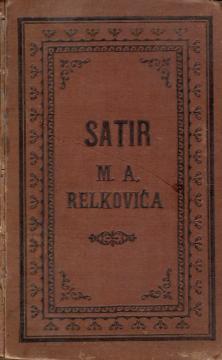
Satir
Rare book
Antique
Unique book

Satir

Matija Antun Reljković

Fifth edition of the book from 1871. Original binding. The covers on the spine are slightly cracked in several places and the edges of the covers are slightly frayed. Compact book, pencil signature of the previous owner on the front page.

Satir iliti divji chovik is a satirical-narrative song in 11 cantos published in Dresden in 1762. In his song, Matija Antun Relković (1732 - 1798) describes the beauty of the Slavonian land and the neglect of the Slavonian peasants, for which he blames customs that he believes originated under Turkish influence. He introduces into the song an ancient mythological being, the Satyr, who advises Slavonians how to cultivate the land. The first edition had a lot of success, and even in the polemic about the work, positive echoes prevailed. In the second edition, Relković introduced the character of a Slavonian peasant who tells Satir how he accepted his criticisms and improved his work and life. Croatian literary historians judged Satire harshly: they invoked its importance in the process of enlightenment, but they did not find literary beauty in it. Relković viewed nature, especially his native Slavonia, as a physiocrat, i.e. he considered the land his only wealth, and agriculture the noblest and healthiest profession.

Dimensions
17 x 10 cm
Pages
169
Publisher
Naklada Dragutina Harscha, Osijek, 1871.
 
Latin alphabet. Hardcover.
Language: Croatian.

No copies available

The last copy was sold recently.
 

Are you interested in another book? You can search the offer using our search engine or browse books by category.

You may also be interested in these titles

Satir iliti divlji čovik

Satir iliti divlji čovik

Matija Antun Reljković
Glas Slavonije, 1974.
Croatian. Latin alphabet. Hardcover.
3.32 - 3.98
Kako sam ubila svoje dijete

Kako sam ubila svoje dijete

Pierre L'ermite

A moralistic novel written in the form of a confession in which a young woman tells how she had an abortion out of vanity, fear of scandal, and frivolity, and then experiences deep remorse, suffering, and spiritual conversion.

Knjižnica dobrih romana, 1929.
Croatian. Latin alphabet. Hardcover.
9.56
Mirisni vrt šeika Nefzavija

Mirisni vrt šeika Nefzavija

Muḥammad Ibn Muḥammad Al-Nafzawī

A classic 15th-century erotic manual, written by Sheikh Nefzawi at the request of the Sultan of Tunisia. Similar to the Hindu Kama Sutra, it presents an Islamic view of sexuality within marriage, emphasizing harmony and pleasure for partners.

SKD Prosvjeta, 1972.
Croatian. Latin alphabet. Paperback.
7.325.12
Cvijeće sreće moraš saditi sam

Cvijeće sreće moraš saditi sam

Phil Bosmans

Poetic fragments of a Belgian priest who, with the power of spiritual authority, spread the influence of his interesting movement (Union without names) all over the world.

Kršćanska sadašnjost, 1999.
Croatian. Latin alphabet. Hardcover.
9.387.04
Za kravicu

Za kravicu

Jindřich Šimon Baar

"For the Cow" by Jindřich Šimon Baar is a short story about a boy who feels a deep attachment to his cow and, despite poverty and environmental pressures, demonstrates selflessness, responsibility, and moral strength.

Knjižnica dobrih romana, 1930.
Croatian. Latin alphabet. Hardcover.
5.64
​Mladost Njegoševa

​Mladost Njegoševa

Jovan Angelus

"The Youth of Njegoš" by Jovan Angelus is a biographical narrative depicting the early years of the life of Petar II Petrović Njegoš, one of the most important Montenegrin rulers, poets and philosophers.

Jugoreklam, 1982.
Croatian. Latin alphabet. Hardcover.
6.78