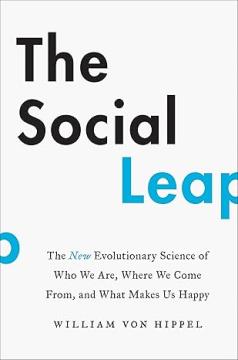
The Social Leap: The New Evolutionary Science of Who We Are, Where We Come From, and What Makes Us Happy

The Social Leap: The New Evolutionary Science of Who We Are, Where We Come From, and What Makes Us Happy

William von Hippel

In The Social Leap, William von Hippel lays out this revolutionary hypothesis, tracing human development through three critical evolutionary inflection points to explain how events in our distant past shape our lives today.

In the compelling popular science tradition of Sapiens and Guns, Germs, and Steel, a groundbreaking and eye-opening exploration that applies evolutionary science to provide a new perspective on human psychology, revealing how major challenges from our past have shaped some of the most fundamental aspects of our being.

The most fundamental aspects of our lives—from leadership and innovation to aggression and happiness—were permanently altered by the "social leap" our ancestors made from the rainforest to the savannah. Their struggle to survive on the open grasslands required a shift from individualism to a new form of collectivism, which forever altered the way our mind works. It changed the way we fight and our proclivity to make peace, it changed the way we lead and the way we follow, it made us innovative but not inventive, it created a new kind of social intelligence, and it led to new sources of life satisfaction.

From the mundane, such as why we exaggerate, to the surprising, such as why we believe our own lies and why fame and fortune are as likely to bring misery as happiness, the implications are far reaching and extraordinary.

Blending anthropology, biology, history, and psychology with evolutionary science, The Social Leap is a fresh and provocative look at our species that provides new clues about who we are, what makes us happy, and how to use this knowledge to improve our lives.

Ilustracije
Jason Tangen
Naslovnica
Andrea Guinn
Dimenzije
23,5 x 16 cm
Broj strana
291
Nakladnik
HarperCollins Publishers, New York, 2018.
 
Latinica. Tvrde korice s ovitkom.
Jezik: Engleski.
ISBN
978-0-06274-039-7

Nema primjeraka u ponudi

Poslednji primjerak je nedavno prodan.


Zanima Vas i neka druga knjiga? Možete pretražiti našu ponudu pomoću tražilice ili prelistati knjige po kategorijama.

Možda će Vas zanimati i ovi naslovi

National Geographic Hrvatska #9: Globalno upozorenje - Izvješća iz sve toplijeg svijeta

National Geographic Hrvatska #9: Globalno upozorenje - Izvješća iz sve toplijeg svijeta

Adria media, 2004.
Hrvatski. Latinica. Broširano.
2,00
Otkriće Troje

Otkriće Troje

Vojtech Zamarovsky

"The Discovery of Troy" by Vojtěch Zamarovsky is a book that describes in detail the history of the discovery of the ancient city of Troy, with special emphasis on the archaeological research of Heinrich Schliemann.

Epoha, 1964.
Hrvatski. Latinica. Tvrde korice s ovitkom.
8,56
Ekspedicije u nepoznato: historija velikih geografskih otkrića na našoj planeti

Ekspedicije u nepoznato: historija velikih geografskih otkrića na našoj planeti

Erich Rackwitz

The work was originally published in 1959 and was awarded the first prize for the promotion of literature for children and young people in 1960 and has been translated into several languages. As a follow-up, Rackwitz wrote "Sunken Worlds - Far S

Epoha, 1965.
Hrvatski. Latinica. Tvrde korice s ovitkom.
9,786,85
National Geographic Hrvatska #6: Duboko pod morem - Monterejski kanjon

National Geographic Hrvatska #6: Duboko pod morem - Monterejski kanjon

Adria media, 2004.
Hrvatski. Latinica. Broširano.
2,00
Povijest otkrića i istraživanja 3: Zemlje mirodija i blaga

Povijest otkrića i istraživanja 3: Zemlje mirodija i blaga

William Napier, John Gilbert, Julian Holland

The book describes man's discoveries of parts of planet Earth that were accidental or planned. The period from 50,000 years ago to today's efforts in space exploration is described.

Mladinska knjiga, 1977.
Hrvatski. Latinica. Tvrde korice.
37,26 (komplet)
Bogatstvo mora

Bogatstvo mora

T. S. Douglas

The book provides a comprehensive overview of the potential of the sea as a source of various resources, emphasizing the importance of their sustainable exploitation for future generations.

Hrvatsko prirodoslovno društvo, 1951.
Hrvatski. Latinica. Tvrde korice s ovitkom.
6,24