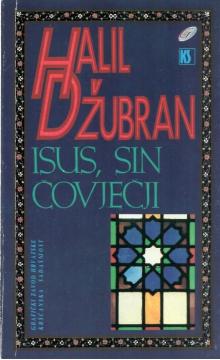
Isus, sin čovječji

Isus, sin čovječji

Halil Džubran

Aramaic, which Jesus spoke, was a second language to Jubran. The atmosphere and appearance of Judea enchants the reader who, moving through the scenes from those days and that country, is aware of something much more sublime than the words on the title pa

We see the young man from Nazareth as we have never seen him, because in Žubran's Jesus, for the first time since the Gospels were written, a countryman of Jesus writes about his words and deeds. Džubran did his job exceptionally well. He performed it with the unique strength of a man fully familiar with the social, political and religious conditions in Palestine, Syria and Rome at that time, a man who knows well the richness and significance of tradition, and the history and language of the homeland of Jesus.

Original title
Jesus, the Son of Man
Translation
Olga Vučetić, Marko Grčić
Graphics design
Zoran Pavlović
Dimensions
18 x 11 cm
Pages
181
Publisher
Kršćanska sadašnjost, Zagreb, 1991.
 
Distribution: 3,000 copies
 
Latin alphabet. Paperback.
Language: Croatian.
ISBN
8-63-990263-1

No copies available

The last copy was sold recently.
 

Are you interested in another book? You can search the offer using our search engine or browse books by category.

You may also be interested in these titles

Mirisni plodovi duše

Mirisni plodovi duše

Halil Džubran

Fragrant Fruits of the Soul (the title of the Croatian edition) is a collection of poetic prose, aphorisms, meditations, and lyrical fragments. Like other early works, it exudes mystical longing, a spiritual rebellion against materialism, and a search for

Kršćanska sadašnjost, 1990.
Croatian. Latin alphabet. Paperback.
5.46
Suza i osmijeh

Suza i osmijeh

Halil Džubran

A collection of short lyrical prose writings, poems, and reflections from Gibran's early work. Published in 1914, the work belongs to his Arabic period and exudes mystical longing, spiritual quest, and acceptance of the duality of life.

Kršćanska sadašnjost, 1990.
Croatian. Latin alphabet. Paperback.
5.48
Od zore do mraka

Od zore do mraka

Fran Mažuranić

The collection represents the author's return to literature after almost four decades of silence. It consists of short prose texts - sketches - that are more plot-rich and reflective than his earlier collection, Leaves from 1887.

Matica hrvatska, 1927.
Croatian. Latin alphabet. Hardcover.
5.42
Nasljednik indijskog cara : Jakša Kušan od 1500. godine pr. Kr. do 1980.

Nasljednik indijskog cara : Jakša Kušan od 1500. godine pr. Kr. do 1980.

Ivan Kušan

Autobiographical prose by Ivan Kušan, in which the author tells the story of the life of his father, Jakša Kušan, from a personal and family perspective. Through Ivan Kušan's memories, we follow Jakša Kušan in pre-war Sarajevo, wartime and post-war Zagreb

Naklada Ljevak, 2000.
Croatian. Latin alphabet. Paperback.
4.76
Prelazni period: Dnevnik posmatrača

Prelazni period: Dnevnik posmatrača

Mihailo Lalić

„Prelazni period“ je roman crnogorskog i srpskog pisca Mihaila Lalića, objavljen 1988. godine. Rad ima podnaslov „Dnevnik jednog posmatrača“, što sugeriše introspektivan i refleksivan pristup pripovedanju.

Nolit, 1988.
Croatian. Latin alphabet. Hardcover.
7.52
Pjesnik govori: filozofsko-estetske kozerije

Pjesnik govori: filozofsko-estetske kozerije

Drago Ćepulić

"The Poet Speaks: Philosophical-Aesthetic Riddles" by Dragutin (Drago) Ćepulić is a collection of short, thoughtful essays in which the author reflects on literature, art, philosophy, and human creativity in a witty, insightful, and unobtrusive manner.

Minerva nakladna knjižara, 1943.
Croatian. Latin alphabet. Paperback.
6.244.68