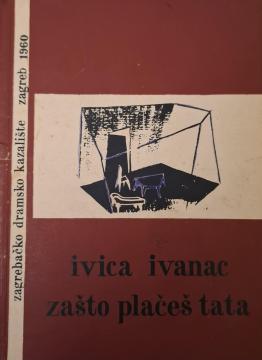
Zašto plačeš tata?

Zašto plačeš tata?

Ivica Ivanac

It is a work that deals with difficult post-war themes, personal tragedies, emotional wounds, and relationships within the family, especially between fathers and children.

The novel is set in the aftermath of World War II and follows the life of a father trying to find peace and rebuild his family after the great losses he suffered in the war. The central figure is the father, whose inner struggles and emotional breakdowns are gradually revealed through his relationships with his son and his family's past.

Illustrations
Rudolf Sablić, Aleksandar Augustinčić
Graphics design
Rudolf Sablić, Aleksandar Augustinčić
Dimensions
16 x 12 cm
Pages
62
Publisher
Zagrebačko dramsko kazalište, Zagreb, 1960.
 
Latin alphabet. Paperback.
Language: Croatian.

One copy is available

Condition:Used, excellent condition
 

Are you interested in another book? You can search the offer using our search engine or browse books by category.

You may also be interested in these titles

Život pod reflektorima: 7 suvremenih drama i komedija

Život pod reflektorima: 7 suvremenih drama i komedija

Mirko Božić, Pero Budak, Vladan Desnica, Fadil Hadžić, Ivica Ivanac, Marijan Matković, Duško Roks...
NIP, 1961.
Croatian. Latin alphabet. Hardcover with dust jacket.
11.99
Kako što nastaje: novine, film, teatar

Kako što nastaje: novine, film, teatar

Karel Čapek

In a witty and instructive essay, Čapek describes how a newspaper, a film, and a theater play are created. Through humor and irony, he shows the complexity of the process – from idea to realization – and the different perspectives of the participants, dem

Znanje, 1985.
Croatian. Latin alphabet. Paperback.
4.76
Kronika o glazbenoj i dramskoj djelatnosti u Belišću 1890.-1990.

Kronika o glazbenoj i dramskoj djelatnosti u Belišću 1890.-1990.

Dragutin Gibičar
Gradsko poglavarstvo, 2008.
Croatian. Latin alphabet. Paperback.
9.98
Mimesis i konstrukcija

Mimesis i konstrukcija

Sabudin Musabegović

The book "Mimesis and Construction" (2009) by Sabudin Musabegović deals with the theoretical consideration of art, literature and the way in which meaning is created in the text.

Akademija likovnih umjetnosti, 2009.
Croatian. Latin alphabet. Paperback.
9.85
Kazališne veze Osijeka i Pečuha / Eszék és Pécs színházi kapcsolata

Kazališne veze Osijeka i Pečuha / Eszék és Pécs színházi kapcsolata

Zvonimir Ivković

The book provides a thorough chronicle and analysis of centuries-old theatrical contacts between two cities – Osijek and Pécs – which historically shared the cultural space of the Pannonian Plain, especially during the period of the Habsburg Monarchy.

Matica hrvatska, 2012.
Croatian. Latin alphabet. Hardcover.
13.64
Sophocles' Tragic World: Divinity, Nature, Society

Sophocles' Tragic World: Divinity, Nature, Society

Charles Segal
Harvard University Press, 1998.
English. Latin alphabet. Paperback.
13.12