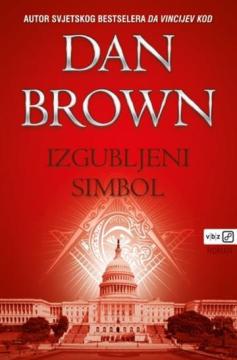
Izgubljeni simbol
The novel The Lost Symbol (2009), the third in the Robert Langdon series after Angels & Demons and The Da Vinci Code, is a suspenseful thriller by Dan Brown set in Washington, D.C., within a 12-hour time frame.
Dan Brown, after six years of research into Freemasonry, Masonic symbols, and noetic science, creates a labyrinth of secrets that weaves together history, religion, and science in a dizzying rhythm. The protagonist, Harvard symbology professor Robert Langdon, is invited to the US capital to give a lecture for the Smithsonian. Instead, however, he is drawn into a nightmare: his close mentor, Freemason Peter Solomon, has been kidnapped by the mysterious tattooed assassin Mal'akh, who is searching for the "lost symbol" - a pyramid that hides an ancient Masonic secret capable of changing the world. Langdon receives a message: a small pyramidal object with five engraved symbols, which he must decipher in order to save his friend.
Accompanied by Peter's sister Katherine Solomon, a brilliant noetic scientist who explores the power of thought and collective consciousness, Langdon navigates hidden tunnels, corridors, and secret chambers beneath the Capitol, the White House, and other landmarks. They encounter CIA Director Inoue Ashima, Agent Nunez, and Masonic guards as they are pursued by a dangerous adversary. The plot leads through the symbols on the Great Seal of the United States, the Washington Monument, the pyramid on banknotes, and legends of Masons such as George Washington and Benjamin Franklin.
Brown masterfully interweaves fact with fiction: Masonic rituals, alchemy, the Bible, and modern science, mocking the boundaries between faith and reason. Langdon, a skeptic, confronts questions about hidden knowledge that could unlock human potential. The novel criticizes fanaticism and celebrates exploration, keeping the reader in suspense through unexpected twists and a fast pace.
One copy is available