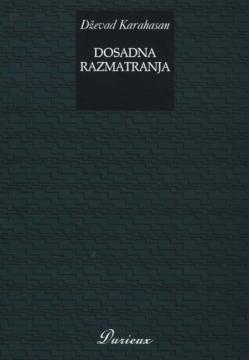
Dosadna razmatranja

Dosadna razmatranja

Dževad Karahasan

Dževad Karahasan, a Bosnian novelist, essayist and theater scholar, in his collection of essays Boring Considerations, written during his forced exile from Sarajevo due to the war, dissects European prejudices and intellectual arrogance towards the Balkan

The book, divided into parts such as Memories and Shadow Geography, ends with polemics against the simplification of Bosnian culture as a "dynamic mosaic" of modernity and tradition.

Through irony, cynicism and indignation, Karahasan addresses imaginary interlocutors from the German context – a temporary refuge – criticizing self-proclaimed experts who "interpret" events at the borders of Europe. Europe sees itself as tolerant, open and dialogic, but ignores reality: war trauma, exile and the complexity of Bosnian identity. The author argues not only with them, but also with the reader, exposing the rationalist ideology of reason as a cover for ignorance - established intellectuals are "completely ignorant", and those who really understand are outsiders like Karl May, who "loved and understood the Indians".

Essays such as Migration of Borders explore the "poetics of ruin" – the collapse of civilization, the boundaries of culture, and exile as an existential limbo. Karahasan takes issue with the obsession with rationalism, where the world is reduced to logic and the Balkans to stereotypes. This book, as a response to the "kitsch sensibility" of the West, celebrates dialogue with the Other, but warns of the danger of simplification: Bosnia is not an exotic "East", but a mirror of European weaknesses. With erudition and bitterness, it remains a testimony to spiritual alienation in an era of war, where reflections are not boring, but painfully necessary.

Editor
Ivan Lovrenović, Nenad Popović
Dimensions
20 x 13 cm
Pages
164
Publisher
Durieux, Zagreb, 1997.
 
Latin alphabet. Paperback.
Language: Croatian.

One copy is available

Condition:Unused
 

Are you interested in another book? You can search the offer using our search engine or browse books by category.

You may also be interested in these titles

Sjeme smrti

Sjeme smrti

Dževad Karahasan

The first book of a multi-volume novel about Omar Khayyam, the great Persian mathematician, astronomer, and poet from the 12th century.

Profil Knjiga, 2012.
Croatian. Latin alphabet. Paperback.
9.46 - 9.58
Dnevnik melankolije

Dnevnik melankolije

Dževad Karahasan

Dževad Karahasan (1953–2023), a Bosnian-Herzegovinian essayist and theater scholar, fills the void of the lack of interest in drama and theater in contemporary literature in his collection Dnevnik melankolije.

Vrijeme, 2021.
Croatian. Latin alphabet. Paperback.
11.26
Rani dani - Kako smo odrastali uz filmove i televiziju

Rani dani - Kako smo odrastali uz filmove i televiziju

Goran Tribuson

In his autobiographical prose, Early Days (1997), Goran Tribuson evokes childhood and early adulthood in Bjelovar through the prism of film and television. An extraordinarily humorous story about ordinary life in the 1960s.

Znanje, 1997.
Croatian. Latin alphabet. Paperback.
8.24
Od zore do mraka

Od zore do mraka

Fran Mažuranić

The collection represents the author's return to literature after almost four decades of silence. It consists of short prose texts - sketches - that are more plot-rich and reflective than his earlier collection, Leaves from 1887.

Matica hrvatska, 1927.
Croatian. Latin alphabet. Hardcover.
5.42
Pjesme i eseji

Pjesme i eseji

Antun Branko Šimić

"Poems and Essays" by A. B. Šimić is a posthumous publication that brings together selected poems and essays by one of the key figures of Croatian expressionism. This selection of his poetry and essays was edited by Vesna Krmpotić.

Matica hrvatska, 1964.
Croatian. Latin alphabet. Paperback.
7.96 - 8.32
Naši ljudi i krajevi: Pejzaži, novele, crtice

Naši ljudi i krajevi: Pejzaži, novele, crtice

Antun Gustav Matoš, Fran Mažuranić

"Our People and Regions" is a collection of essays and travelogues by A. G. Matoš from 1910. The collection provides a deep insight into the Croatian regions and people of the early 20th century, reflecting Matoš's love for his homeland and his ability to

Spektar, 1974.
Croatian. Latin alphabet. Hardcover.
6.24