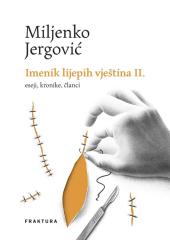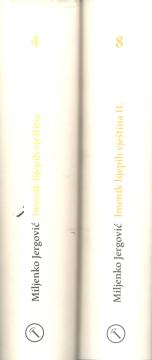
Imenik lijepih vještina I-II

Imenik lijepih vještina I-II

Miljenko Jergović

In The Directory of Fine Arts, Miljenko Jergović explores diverse topics, from literature to history, celebrating art and excellence. His essays offer deep understanding, imbued with intellectual passion and a love of the written word.

On the large and indented map of Jergović's literary opus, which is still in the process of formation and growth, equally on all its genre and thematic isohips, a special place belongs to the discursive text. Even with his first newspaper texts, for which he received the Veselko Tenžera Award in 1990, at that time the most powerful recognition of its kind in Yugoslavia, Jergović demonstrates a distinctly individualized style, which easily breaks through the typological boundaries of essays, columns, comments, personal memories and narrative prose, merging everything into a specific amalgam of Jergović's essayism. Over time, the thematic register of his interests expands in huge concentric circles: literature and books above all, but also film, painting, music (all: classical, new, folk...), comics, football, nascent reality with all its wonders, rarely good, most often evil, political history, identity dramas of the post-Berlin era, with a special sensitivity to the social position of all kinds of minorities... Jergović's essay: a testimony to an insatiable spiritual hunger to encompass, or at least touch the totality of reality, the entire world with a text. It is an astonishing and somewhat terrifying hunger, magnificent and, of course, futile. Futility? It is to be assumed that the author is also familiar with it, because he himself gives numerous indications of it in his texts, and his intransigence in the daily execution of the aforementioned plan and his faith in the Text as the last stronghold of meaning, suggest something of a stoically mastered reconciliation. But all of this would be secondary if it weren't for the immense power of writing, of language, through which Jergović's text engages us, disturbs us, provokes us, and, above all, arouses genuine reader excitement. — Ivan Lovrenović

Editor
Ivan Lovrenović
Illustrations
Vedran Klemens
Graphics design
Vedran Klemens
Dimensions
21 x 15 cm
Pages total
1164
Publisher
24 sata, Zagreb, 2018.
 
Latin alphabet. Hardcover with dust jacket.
Language: Croatian.
ISBN
978-9-53358-061-6

The book consists of two volumes.

Jedan višetomni primjerak je u ponudi.
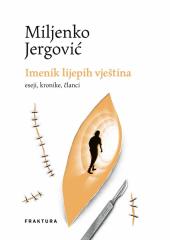
Imenik lijepih vještina I-II
Volume 1
Pages: 624
Condition:Used, excellent condition
Imenik lijepih vještina I-II
Volume 2
Pages: 560
Condition:Used, excellent condition
 

Are you interested in another book? You can search the offer using our search engine or browse books by category.

You may also be interested in these titles

Gloria in excelsis

Gloria in excelsis

Miljenko Jergović
Jutarnji list, 2005.
Croatian. Latin alphabet. Paperback.
4.56 - 4.98
Sarajevski Marlboro

Sarajevski Marlboro

Miljenko Jergović

A collection of 29 short stories depicting the everyday life of the inhabitants of Sarajevo during the war. The author portrays the reality of war without pathos, focusing on small details that reflect human resilience and the complexity of life in extrem

Jutarnji list, 2004.
Croatian. Latin alphabet. Hardcover with dust jacket.
4.88 - 5.20
Historijska čitanka 1

Historijska čitanka 1

Miljenko Jergović

The cult book by Miljenko Jergović – a subjective history of a time, country and city... A historical reader is actually a family album because a person always becomes familiar with people in a time that has passed and which they want to explain.

V.B.Z, 2006.
Croatian. Latin alphabet. Paperback.
6.22
Moj život

Moj život

Richard Wagner

The autobiography of the German composer, reformer of modern opera, and one of the most revered artists of the 19th century. This deeply personal work covers Wagner's childhood, artistic development, and key moments up to 1864.

Zora, 1966.
Croatian. Latin alphabet. Hardcover with dust jacket.
9.36
Dnevnici, 2. svezak: 1912-1914.

Dnevnici, 2. svezak: 1912-1914.

Franz Kafka

The second volume of Kafka's diaries covers the crucial years 1912–1914. This volume is a bridge between the early sketches and the mature novels, and the fragments are raw, aphoristic, full of self-mutilation, but also ingenious introspection.

Tim press, 2022.
Croatian. Latin alphabet. Paperback.
16.34
Po zanimanju samoubica: Romansirana autobiografija 1.

Po zanimanju samoubica: Romansirana autobiografija 1.

Oskar Davičo
Oslobođenje, 1988.
Serbian. Latin alphabet. Paperback.
9.467.57