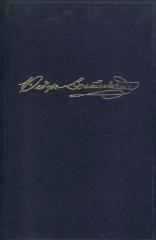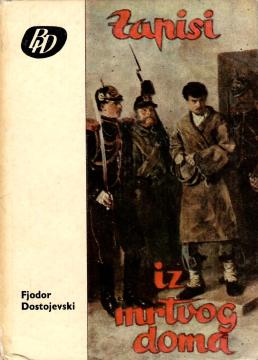
Zapisi iz mrtvog doma
Rare book

Zapisi iz mrtvog doma

Fjodor Mihajlovič Dostojevski

Notes from the House of the Dead (1861–1862) is one of the most poignant and realistic depictions of the human soul in hell, where horror turns into a deep understanding of man, his suffering, and unexpected strength.

Dostoevsky wrote the book immediately after his return from the Siberian penitentiary in Omsk, where he spent four years of hard forced labor (1850–1854) after being sentenced to death (which was commuted at the last moment) for his participation in Petrashevsky's circle. Instead of writing a burning accusation against the tsarist regime, he chooses a calmer, almost documentary approach: he shows life in the "dead house" through the eyes of the fictional narrator Alexander Petrovich Gorjanchikov, a nobleman sentenced to ten years in prison for the murder of his wife.

It is not a linear story, but a series of episodes, portraits, observations - the daily life of prisoners: work in chains on the river, the misery of the barracks, hunger, diseases, the brutality of the guards, but also unexpected moments of humanity. We meet a variety of characters: a Tatar who dreams of freedom, an Old Believer who reads the Bible, a young murderer who still has boyish innocence in his eyes, Gypsies, Poles, peasants. Dostoevsky does not idealize either the convicts or the guards – he shows how prison grinds everything, but also how nobility, humor, and even spiritual depth can shine through in the lowest strata of society.

The most moving parts are those where the truth about man breaks through the small details: how the convicts cling to life through small rituals (Christmas, bathing in the steam room, illegal drinking), how suffering can awaken the conscience, but also how the soul can harden beyond recognition. The book is full of quiet, almost Christian hope – Dostoevsky sees in these "dead souls" a spark of the divine, something that makes them alive despite everything.

The style is restrained, precise, without pathos – that is what makes it so powerful. There are no grand monologues, no philosophical digressions like in later novels; only the bare truth about human nature in extreme conditions. This work is key to understanding the whole of Dostoevsky: from that "dead home" emerged a writer who knew that man is capable of the worst, but also of the greatest.

Original title
Записки из Мёртвого дома
Translation
Milosav Babović
Editor
Milica Grabovac
Dimensions
17 x 12 cm
Pages
343
Publisher
Svjetlost, Sarajevo, 1961.
 
Latin alphabet. Hardcover.
Language: Serbian.

One copy is available

Condition:Unused
 

Are you interested in another book? You can search the offer using our search engine or browse books by category.

You may also be interested in these titles

Dečko

Dečko

Fjodor Mihajlovič Dostojevski
Rad, 1988.
Serbian. Latin alphabet. Hardcover.
7.64
Ujakov san / Poniženi i uvrijeđeni

Ujakov san / Poniženi i uvrijeđeni

Fjodor Mihajlovič Dostojevski

Both works reflect Dostoevsky's early phase, with a focus on social criticism, psychological analysis and moral dilemmas, foreshadowing the themes of his later masterpieces.

Znanje, 1982.
Croatian. Latin alphabet. Hardcover.
13.269.95
Mladac

Mladac

Fjodor Mihajlovič Dostojevski

The Young Man (1875) by Fyodor Dostoevsky is a complex novel about coming of age, moral struggles, and social conflicts in 19th-century Russia. The novel, although less well-known, is a powerful portrayal of internal struggle and social tensions, with an

Znanje, 1982.
Croatian. Latin alphabet. Hardcover.
11.509.20
Mrtvi kapitali

Mrtvi kapitali

Josip Kozarac

"Dead Capitals" (1890) is one of the most important works of Croatian realism and a strong critique of the social stagnation of the time. The novel shows the economic and social neglect of Slavonian villages under the Austro-Hungarian Empire through the c

Mladost, 1961.
Croatian. Latin alphabet. Paperback with dust jacket.
3.82 - 3.98
San vodoslikara 1-5: Majstor senki / Podražavanje Sunca I-II / U Sinu Božjem I-II

San vodoslikara 1-5: Majstor senki / Podražavanje Sunca I-II / U Sinu Božjem I-II

Vladan Dobrivojević

In terms of the criticism of the civilization drive, the depth of the vision, the rounded philosophical structure, the birth of a new language, the sentence structure - Dobrivojević is probably the greatest writer who has appeared in the last 30 years.

Draslar - Partner, 2009.
Serbian. Cyrillic alphabet. Hardcover with dust jacket.
The book consists of 5 volumes
47.64
Bogorodičina crkva u Parizu

Bogorodičina crkva u Parizu

Victor Hugo

At the center of Hugo's monumental work and one of the most significant novels of French literature, there are three exceptional characters caught in a web of passion and revenge.

Svjetlost, 1982.
Croatian. Latin alphabet. Hardcover.
4.82