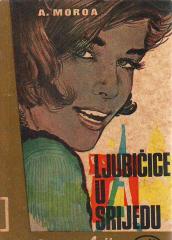
Ljubavna pustolovina Pierrea Vignala
Antique
Rare book

Ljubavna pustolovina Pierrea Vignala

Armand Mercier

"The Love Adventure of Pierre Vignal" by Armand Mercier is a short Gothic novel about love passions, secrets and dramatic events. Light, romantic-sensational prose by the French author.

Armand Mercier was a French author of popular fiction between the two world wars. He wrote novels with romantic, adventurous and sometimes Gothic elements – a mixture of love story, intrigue and dramatic plots. In Croatia (and the then Kingdom of Yugoslavia) such editions were very popular among readers who were looking for light, entertaining literature.

The plot follows Pierre Vignal, whose love adventure leads through passionate relationships, hidden secrets, jealousies and unexpected twists. As a typical Gothic/Romantic novel of the period, the book contains elements of mystery, emotional conflicts, but also some darker motives, which is highlighted on the cover and in advertisements as a "Gothic novel".

The style is simple, fast and effective – typical of mass fiction of the 1930s. Mercier does not strive for deep psychology or high literature, but rather leads the reader through a dynamic story full of tension and romantic scenes. The language of the translation is accessible, adapted to the tastes of the audience at the time.

This Osijek edition from 1936 is today an extremely rare and sought-after antiquarian copy. It testifies to the lively publishing activity in the province and the popularity of French light literature in Croatia before World War II. Similar editions (romance novels, adventures, Gothic stories) were a kind of "yellow press" of the time - cheap, entertaining and widely read.

Original title
L'aventure amoureuse de Pierre Vignal
Dimensions
20 x 14 cm
Pages
88
Publisher
Naklada "Hrvatskog lista", Osijek, 1936.
 
Latin alphabet. Paperback.
Language: Croatian.

One copy is available

Condition:Used, very good condition
Specificity of this instance:
Bound
 

Are you interested in another book? You can search the offer using our search engine or browse books by category.

You may also be interested in these titles

Evgenija Grande

Evgenija Grande

Honore de Balzac

"Eugénie Grandet" (1833), part of Balzac's Human Comedy, is a realistic novel that explores greed, family relationships, and the sacrifices of love in provincial French society.

Veselin Masleša, 1989.
Croatian. Latin alphabet. Hardcover.
4.98
Čovek naopako

Čovek naopako

Philippe Curval

The French writer Philippe Kirval is a well-known representative of the modern direction of science fiction in his country. The author of twelve novels, Kirval relatively early discovered the assumption of the existence of countless "parallel universes" a

Jugoslavija, 1978.
Serbian. Latin alphabet. Paperback.
2.98
Neoprezni putnik

Neoprezni putnik

René Barjavel

It could be said that René Barjavel gave new momentum to science fiction and thereby gained the reputation of a modern classic, a recognized predecessor of modern generations of French writers who continue a highly valued tradition.

Jugoslavija, 1979.
Serbian. Latin alphabet. Paperback.
3.98 - 4.76
Evgenija Grande / Muzej starina

Evgenija Grande / Muzej starina

Honore de Balzac

In his novels Eugenie Grandet (1833) and The Museum of Antiquities (1837), Balzac explores universal themes of greed, human passions, sacrifice, and moral dilemmas, placing them in different social contexts of 19th-century French society.

Svjetlost, 1963.
Croatian. Latin alphabet. Hardcover.
3.48
Svilena klopka

Svilena klopka

Françoise Sagan

In The Silk Trap, Françoise Sagan depicts a love trap woven from passion, irony, and self-deception. Adrian, a cynical writer, is caught between success, boredom, and an elusive woman who changes his perspective on life.

Mladost, 1990.
Croatian. Latin alphabet. Hardcover with dust jacket.
4.98 - 7.36
Čovek od gipsa

Čovek od gipsa

Joseph Kessel

The novel, whose original title is L'Homme de plâtre, explores complex human destinies through the story of a protagonist whose life symbolically reflects fragility and vulnerability, like plaster.

Minerva, 1987.
Serbian. Latin alphabet. Hardcover.
4.64