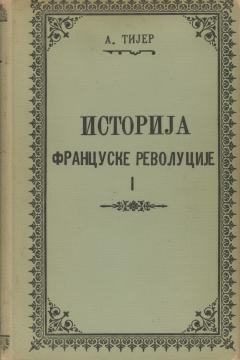
Istorija Francuske revolucije I
Thiers' "History of the French Revolution I" shows the causes of the Revolution, the collapse of absolutism and the beginning of political turmoil in France, and the events of 1789 - the Parliament of the Stales, the National Assembly, the Bastille.
Adolphe Thiers in his work History of the French Revolution I provides a comprehensive and chronologically elaborated account of the initial phase of the French Revolution, from the deep causes of the collapse of the absolutist monarchy to the first revolutionary upheavals of 1789. The Serbian edition of the work was published in Belgrade in the period 1899–1903 by the State Printing House, as a comprehensive serial undertaking in 24 volumes collected in 6 volumes.
Thiers analyzes the social, political and economic tensions in France on the eve of the Revolution, emphasizing the crisis of the old regime, the fiscal collapse of the state and the pronounced inequality of the estates. The position of the Third Estate, which becomes the main carrier of political mobilization and demands for reforms, is presented in particular detail.
At the center of the narrative are the Estates of State, their convocation in 1789 and the gradual transformation into the National Assembly, which begins the institutional disintegration of the absolute monarchy. Special attention is paid to events such as the oath in the ballroom, the debate on the constitutional order, and the initial conflicts between the royal authorities and the revolutionary representatives. Thiers also describes the atmosphere of political tension in Paris, including popular discontent that culminates in symbolic events such as the fall of the Bastille.
The work is characterized by a lively, narratively shaped style that presents historical events almost dramatically, but with a clear political-analytical interpretation. Thiers does not view the Revolution simply as a series of events, but as a complex process of the collapse of the old order and the birth of a new political system.
The significance of the work lies in the fact that it represents one of the most influential great syntheses of the French Revolution in 19th-century European historiography. Thiers shaped a long-lasting interpretative framework for the Revolution, combining narrative vividness and political analysis, and his work strongly influenced later historians and the shaping of public perception of revolutionary events.
The Serbian edition is additionally important because it enabled the spread of this historiographic tradition in the South Slavic cultural space at the end of the 19th and beginning of the 20th centuries.
One copy is available
- Worn covers
- Traces of patina