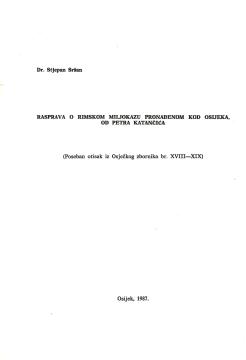
Rasprava o rimskom miljokazu pronađenom kod Osijeka
In his study from 1782, Petar Katančić scientifically examines a Roman milestone found near Osijek (Mursa), making a pioneering contribution to the ancient archaeology of Slavonia and Pannonia.
A Discussion of a Roman Milestone Found near Osijek by Matija Petar Katančić (1750–1825) is one of the earliest scholarly publications on ancient monuments in Croatia. First printed in Osijek in 1782, and again in Zagreb in 1794, this study represents a pioneering work in Croatian archaeology and epigraphy.
Katančić, a priest, poet, and prominent scholar of the ancient past, describes in detail a milestone (milepost) discovered near Osijek, ancient Mursa – an important Roman traffic and military center on the Danube. The work contains a transcription and interpretation of the Latin inscription on the pillar, the historical context of Roman road construction in Pannonia, and an analysis of the distance and significance of milestones within the Roman road system.
In the preface and introductory sections, Katančić demonstrates exceptional scientific method for his time: a critical approach to sources, knowledge of classical literature (especially Ovid), and a love of his homeland and science that inspired him to research. The work is dedicated to Count Kristoforo Niczko, and also contains poetic elements – quotes from Ovid that emphasize the author's connection with the region and ancient heritage.
The translator dr. Stjepan Sršan translated the Latin original into Croatian, trying to preserve Katančić's style and spirit, with numerous notes that make it easier for the modern reader to understand the professional terminology and historical context. The Croatian translation is accompanied by a German summary (Zusammenfassung) that presents the work to a wider audience.
The significance of Katančić's treatise lies in the fact that it is the first systematic scientific work on Roman monuments in the Slavonian region, which was also recognized by Theodor Mommsen. Despite the passage of more than 240 years, the study remains a valuable source and testimony to the early interest in Croatian ancient heritage. By translating this work, a contemporary publisher makes accessible a pioneering work of Croatian archaeology and enables a new appreciation of Katančić's contribution to 18th-century European science.
One copy is available