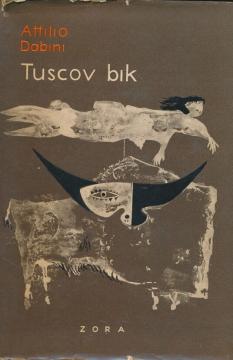
Tuscov bik

Tuscov bik

Attilio Dabini

The adventure-historical novel by Attilio Dabini takes readers to ancient Etruria. Through an exciting story and mythological motifs, the author shows the struggle for freedom, power and honor among the Etruscan tribes.

This suspenseful novel by Italian writer Attili Dabini is set in the mysterious and opulent world of ancient Etruria, a mysterious civilization that flourished on the Apennine Peninsula before the rise of the Roman Republic. Through the title motif of the "Bull of Tusca" — symbolizing the strength, sacred animal deity, and ruling power of the ancient Etruscans — the author weaves an exciting narrative filled with battles, mystical rituals, and political intrigue. The plot follows the fates of brave warriors, priests, and nobles who find themselves at the center of the conflict for supremacy and survival of their people. Dabini brings to life the customs, religious beliefs, ritual battles, and daily life of the Etruscan city-states with an exceptional sense of detail. The protagonists must face not only external dangers and rival tribes, but also internal betrayals, forbidden loves, and the unwavering will of their gods. The writing style is characterized by a fast pace, vivid descriptions of ancient landscapes and temples, and a pronounced dramatic charge. "The Bull of Tusco" is a valuable read for all lovers of historical novels and adventures that convincingly revive forgotten eras and legends of the European past.

Original title
El toro de Tusco
Translation
Edita Marijanović
Editor
Novak Simić
Graphics design
Vladimir Kučina
Dimensions
20 x 14 cm
Pages
178
Publisher
Zora, Zagreb, 1967.
 
Latin alphabet. Hardcover with dust jacket.
Language: Croatian.

One copy is available

Condition:Used, excellent condition
Damages or inconvenience notice:
  • The cover is missing
 

Are you interested in another book? You can search the offer using our search engine or browse books by category.

You may also be interested in these titles

Djevojka s Leicom

Djevojka s Leicom

Helena Janeczek

The novel is a kaleidoscopic, polyphonic account of the life of Gerda Taro (née Gerda Pohorylle, 1910–1937), the first female war photographer to die on the battlefield. A must-read for fans of historical fiction about strong women and anti-fascism.

Naklada Ljevak, 2020.
Croatian. Latin alphabet. Hardcover with dust jacket.
13.72
Rimske priče: izbor

Rimske priče: izbor

Alberto Moravia

Collections of short stories from Roman life in the post-war era: ordinary people from the people and the petty bourgeoisie – the poor, workers, small craftsmen – face misery, survival, jealousy, petty deceit and moral compromises in everyday life.

Otokar Keršovani, 1966.
Croatian. Latin alphabet. Hardcover.
3.98
Eugenio Montale: izbor tekstova

Eugenio Montale: izbor tekstova

Eugenio Montale

In any case, I'm here, because I wrote poems, an absolutely useless product, but almost never harmful, and in that lies some of its nobility," said the Italian Nobel laureate Montale at the award ceremony.

Školska knjiga, 1993.
Croatian. Latin alphabet. Paperback.
5.98
Predvojeni vikont

Predvojeni vikont

Italo Calvino

The Biscounted Viscount is a novel by Italo Calvino published in 1952. It is the first part of the Our Ancestors trilogy, which also includes the short novels The Baron in the Trees from 1957 and The Nonexistent Knight from 1959.

Nolit, 1965.
Serbian. Latin alphabet. Hardcover with dust jacket.
6.32
Kronika o siromašnim ljubavnicima

Kronika o siromašnim ljubavnicima

Vasco Pratolini

In Florence 1925–1926, in the poor Via del Corno, the residents live in love, poverty and fear. The arrival of fascism destroys the community: lovers fight, some die from violence, but popular solidarity survives.

Sveučilišna naklada Liber (SNL), 1982.
Croatian. Latin alphabet. Hardcover with dust jacket.
3.76
Božanstvena komedija: Pakao

Božanstvena komedija: Pakao

Dante Alighieri

Inferno is the first part of Dante's Divine Comedy. In Inferno, he begins his journey with Virgil, who will guide him through all three states of the soul all the way to God himself. This is the second edition of Isa Kršnjavi's translation into Croatian.

Grafički, umjetnički i nakladni zavod Jugoslavija, 1919.
Croatian. Latin alphabet. Hardcover.
48.56