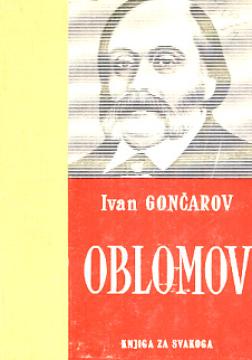
Oblomov

Oblomov

Ivan Gončarov

"Oblomov" follows the nobleman Ilya Ilyich Oblomov, a good-hearted man but paralyzed by laziness and passivity. His inability to act destroys his life, love, and future, pitting him against his active friend, Shtolac.

"Oblomov" by Ivan Goncharov is one of the key novels of 19th-century Russian literature and a profound study of the character and social contradictions of the tsarist era. The main character, Ilya Ilyich Oblomov, is a nobleman who spends almost the entire novel in his apartment, immersed in constant apathy and procrastination. His passivity is not just a personal flaw, but a symbol of the broader social inertia and decline of the class to which he belongs. Oblomov is gentle, emotional and idealistic, but unable to translate any thought into action.

The novel contrasts Oblomov with his opposite – his energetic and practical friend Andrei Shtolac. While Shtolac represents progress, work and modernization, Oblomov embodies nostalgia for a patriarchal, outdated way of life. The novel is given special emotional power by Oblomov's relationship with Olga Ilyina, whose love becomes a test of his ability to change. However, his nature and circumstances overcome his desire for progress, and he retreats into the safety of a routine and static life.

Goncharov uses humor, psychology, and social criticism to portray the inner world of a hero torn between desire and powerlessness. "Oblomov" is at once a tragic and tender portrait of a man who cannot overcome his own nature, but also a metaphor for an entire era on the verge of transformation.

Translation
Milovan Đ. Glišić
Dimensions
17 x 12 cm
Pages
496
Publisher
Branko Đonović, Beograd, 1964.
 
Latin alphabet. Hardcover.
Language: Serbian.

One copy is available

Condition:Used, excellent condition
Discounted price: 5.754.31
25% discount is valid until 6/19/26 11:59 pm
 

Are you interested in another book? You can search the offer using our search engine or browse books by category.

You may also be interested in these titles

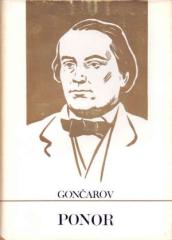
Ponor, sv. 1 – 2

Ponor, sv. 1 – 2

Ivan Gončarov

This two-volume novel follows the life of the main character, a young officer, through various events and challenges.

Veselin Masleša, 1969.
Croatian. Latin alphabet. Hardcover with dust jacket.
The book consists of two volumes
9.36
12 stolica

12 stolica

Ilja Iljf, Jevgenij Petrov

A satirical search for hidden treasure in post-revolutionary Russia. Former nobleman Ippolit Matveyevich Vorobyaninov and con artist Ostap Bender chase after valuables, exposing the greed and absurdities of Soviet society.

Šareni dućan, 2013.
Croatian. Latin alphabet. Hardcover.
16.54
Sabrana djela A. P. Čehova #1: Humoreske

Sabrana djela A. P. Čehova #1: Humoreske

Anton Pavlovič Čehov

This book includes Chekhov's works from 1880-1885, i.e. humoresques, short stories, and sketches, starting with Letters to a Learned Neighbor, which Chekhov considered the beginning of his literary career.

Zora, 1959.
Croatian. Latin alphabet. Hardcover with dust jacket.
9.54
Uzorana ledina

Uzorana ledina

Mihail Šolohov

The novel is set in a Cossack community on the Don River during collectivization in the Soviet Union. The work, divided into two parts, follows the dramatic changes in the village of Gremyachi Log as the Bolsheviks introduce collective farms, which provok

Sveučilišna naklada Liber (SNL), 1980.
Croatian. Latin alphabet. Hardcover with dust jacket.
8.32
Sabrana djela A. P. Čehova #3: Drama u lovu i druge novele

Sabrana djela A. P. Čehova #3: Drama u lovu i druge novele

Anton Pavlovič Čehov

The third volume of Collected Works contains Chekhov's most extensive novella, "A Drama in Hunting," as well as a number of longer stories from the period 1885-1886. There are humoresques such as Silo in a Bag, Eh, That Audience, and A Lot of Paper, as we

Zora, 1959.
Croatian. Latin alphabet. Hardcover with dust jacket.
8.74
Porodica Naljivajko

Porodica Naljivajko

Fjodor Kravčenko
Nakladni zavod Hrvatske, 1948.
Croatian. Latin alphabet. Hardcover with dust jacket.
2.50