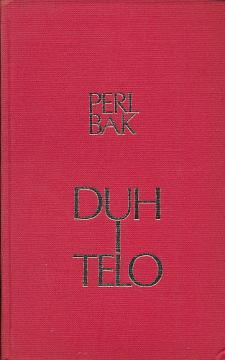
Sabrana dela 5: Duh i telo (Izgnanstvo / Ratoborni anđeo)
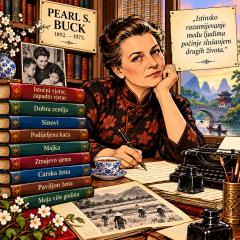
In two memorial portraits, Buck writes about his mother Caroline, a lonely and imaginative exile, and his father Absalom, a stern missionary-warrior—two contrasting souls in the shadow of China.
Exile and Warring Angel (both 1936) are portraits of Pearl S. Buck's parents—memoir-like biographies in which Buck separates her mother and father into two opposing spiritual natures. The Nobel Committee in 1938 singled them out among the reasons for the prize; in 1944 they were published together under the title The Spirit and the Flesh.
Exile is dedicated to her mother, Caroline Stulting Sydenstricker (1857–1921). Buck portrays her as a woman of broad soul and vivid imagination, raised in peaceful West Virginia, whose marriage to a missionary threw her into the strange, harsh China. There Caroline lost seven of her eight children, and with them her own homeland, language, and warmth. Her father was a stranger: absent, cold, devoted to God and China more than to family. Her fate was one of quiet sorrow and relentless resilience; she never belonged to either America or China, remaining in permanent exile.
Warring Angel portrays her father, Absalom Sydenstricker (1852–1931), a Presbyterian missionary. Buck sees him as a “warring angel”—an ascetic, austere, of unwavering faith, who goes to China not out of love for people but for conversion. Here she is ruthless: her father is like an Old Testament prophet, callous towards his wife and children, capable of setting aside everything human for the sake of a heavenly goal.
Together, the two portraits form a meditation on the marriage of two people who have nothing in common except their children—and on the price of devotion: the mother’s, human, warm, defeated; and the father’s, abstract, ascetic, victorious, and empty.
Multiple copies are available