Očevi i djeca

Očevi i djeca

Ivan S. Turgenjev

The novel explores the clash of generations and ideologies in 19th-century Russia, focusing on the conflict between traditionalism and nihilism. Set in rural Russia, the work follows the fates of young intellectuals and their relationships with their fami

The main character, Yevgeny Bazarov, is a charismatic nihilist who rejects tradition, romanticism, and authority, believing only in science and practicality. Together with his friend Arkady Kirsanov, he visits the Kirsanov family, where he clashes with Arkady's father Nikolai and uncle Pavel, who represent an older, more conservative society. Bazarov's radical views cause tension, especially with Pavel, who defends honor and tradition. At the same time, Bazarov falls in love with the wealthy widow Anna Odintsova, but his inability to express his emotions leads to rejection. Arkady, less radical, develops a love affair with Katya, Anna's sister, and gradually returns to more traditional values.

Bazarov's tragic fate comes when he contracts typhus during his medical work, dying in solitude, while Arkady finds happiness in marriage. The novel explores the clash of ideologies, love, family, and the transience of life. Turgenev masterfully depicts the social upheaval in Russia in the 1860s, emphasizing the complexity of the characters and their inner struggles. Fathers and Sons is a classic work of Russian literature, renowned for its psychological depth and social analysis.

Original title
Отцы и дети
Translation
Zlatko Crnković
Graphics design
Halid Malla
Dimensions
20 x 14 cm
Pages
252
Publisher
Globus, Zagreb, 2005.
 
Latin alphabet. Hardcover.
Language: Croatian.
ISBN
978-9-53716-089-0

One copy is available

Condition:Unused
 

Are you interested in another book? You can search the offer using our search engine or browse books by category.

You may also be interested in these titles

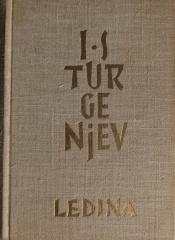
Ledina

Ledina

Ivan S. Turgenjev
Matica hrvatska, 1963.
Croatian. Latin alphabet. Hardcover.
4.98
Lovčevi zapisi

Lovčevi zapisi

Ivan Sergejevič Turgenjev

A collection of 18 short stories (originally 25) by the famous Russian writer Ivan S. Turgenev, published in 1852. The work arose from his experiences as a passionate hunter, and the stories were written during the 1840s and published in the magazine "Sov

Školska knjiga, 1974.
Croatian. Latin alphabet. Paperback.
4.32 - 5.26
Komedije: Ukroćena goropadnica / Mnogo vike ni za što / Na Tri kralja ili Kako hoćete / Sve je dobro što se dobro svrši

Komedije: Ukroćena goropadnica / Mnogo vike ni za što / Na Tri kralja ili Kako hoćete / Sve je dobro što se dobro svrši

William Shakespeare

The Taming of the Shrew, Much Ado About Nothing, Three Kings Day or As You Like It, and All's Well That Ends Well - are masterpieces by the English playwright, known for his wit, romantic plots, and exploration of human relationships.

Globus, 2004.
Croatian. Latin alphabet. Hardcover.
5.24 - 5.36
Božanstvena komedija

Božanstvena komedija

Dante Alighieri

An epic poem written by Dante between 1304 and 1321, his most famous work. It is considered the central epic poem of Italian literature, the last great literary work of the Middle Ages and the first great work that foreshadows the Renaissance.

Globus, 2004.
Croatian. Latin alphabet. Hardcover with dust jacket.
17.32 - 19.7417.92
Izabrane komedije: Tartuffe / Mizantrop

Izabrane komedije: Tartuffe / Mizantrop

Jean-Baptiste Poquelin Molière

Tartuffe is Molière's typical Plautian comedy, written in 1664, when it was first performed. The Misanthrope or Irritable Lover is a comedy of manners, first performed on June 4, 1666, at the Théâtre du Palais-Royal in Paris.

Globus, 2005.
Croatian. Latin alphabet. Hardcover.
6.82 - 7.32
Jadnici

Jadnici

Victor Hugo

An epic tale of redemption, sacrifice and hope, with an emphasis on the moral struggle of the individual in a ruthless society. Hugo's ability to combine philosophical depth with suspenseful action makes the work timeless, and its message of justice and h

Globus, 2005.
Croatian. Latin alphabet. Hardcover.
The book consists of two volumes
26.42