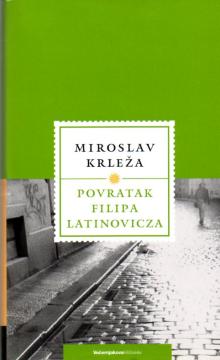
Povratak Filipa Latinovicza

Povratak Filipa Latinovicza
Miroslav Krleža

The Return of Filip Latinovicz is one of Miroslav Krleža's most famous novels. This novel is significant in our literature because it is considered the first fully modern Croatian novel.

The novel does not have a classic composition, or even a fully branched plot, but it is nevertheless complex due to the psychological portrayal and development of the characters, especially the main character, which is the hallmark of a modern novel.

The plot of the novel is set in the twenties of the last century, but the fable is full of digressions, retrospections and thoughts of the characters. The main character, Filip Latinovicz, is a representative of an intellectual misunderstood in a harsh, primitive world. He does not understand such a world, just as this world does not understand him. That is why the emphasis of this novel is on the alienation of the individual from the world, and on his not belonging to the environment in which he is forced to live.

To some extent, this novel is also a novel-essay, because it abounds in long discussions about painting and art in general, since the main character is a painter, and the views expressed are the views of the writer himself. The return of Filip Latinovicz was published in 1932, and to this day it holds a high place on the list of the best Croatian modernist novels.

Editor
Branka Primorac, Seid Serdarević
Illustrations
Stanko Abadžić
Graphics design
Vanja Cuculić
Dimensions
21 x 12.52 cm
Pages
257
Publisher
Večernji list, Zagreb, 2004.
 
Latin alphabet. Hardcover with dust jacket.
Language: Croatian.
ISBN
9-53-985875-5

Multiple copies are available

Copy number 1

Condition:Used, excellent condition

Copy number 2

Condition:Used, excellent condition

Copy number 3

Condition:Unused

Copy number 4

Condition:Used, excellent condition
 

Are you interested in another book? You can search the offer using our search engine or browse books by category.

You may also be interested in these titles

Izabrane pjesme

Izabrane pjesme

Miroslav Krleža

Ovaj izbor Krležinih pjesma presjek je njegove cjelokupne poezije (osim Simfonija i Balada Petrice Kermpuha), uključujući i stihove koji čine sastavni dio širih proznih cjelina čime se pokušala naglasiti povezanost Krležine poezije i proze.

Matica hrvatska, 1963.
Croatian. Latin alphabet. Hardcover with dust jacket.
9.997.99
Hrvatski bog Mars

Hrvatski bog Mars

Miroslav Krleža
Rad, 1965.
Serbian. Latin alphabet. Paperback.
1.99
Andrićeva lestvica užasa

Andrićeva lestvica užasa

Svetislav Basara

Srpski pisac poznat po satiričnim romanima, u Andrićevoj lestvici užasa secira balkanski mentalitet kroz parabolu jugonostalgije i nacionalnih mitova. Naziv aludira na Ivu Andrića kao lakmus-papir za kritiku – Balkanci ga svojataju ili odbacuju po volji.

24 sata, 2021.
Serbian. Latin alphabet. Paperback.
11.56
Kreutzerova sonata, Hadži-Murat

Kreutzerova sonata, Hadži-Murat

Lav Nikolajevič Tolstoj

Krojcerova sonata pripada onim Tolstojevim delima koja je pisac u mnogo čemu prilagodio svom pogledu na moralna pitanja, pre svega na bračni moral.

Civitas, 2004.
Croatian. Latin alphabet. Paperback.
4.98
Stotina godina (antikronika)

Stotina godina (antikronika)

Dario Harjaček

Der Roman „Hundert Jahre“ von Dario Harjaček bietet einen Panoramablick auf Trešnjevka und seine Bewohner im Laufe eines Jahrhunderts voller Veränderungen, Ideologien und menschlicher Schicksale – ein Mosaik von Zagreb, in dem Leben, Kunst und Geschichte

Oceanmore, 2025.
Croatian. Latin alphabet. Paperback.
13.42
Deobe

Deobe

Dobrica Ćosić

„Deobe“ ist ein Roman über die tragische Spaltung der Serben in Tschetniks und Partisanen während des Zweiten Weltkriegs. Der mit dem NIN-Preis ausgezeichnete Roman ist Teil einer größeren epischen Trilogie, die von Ćosićs Erfahrungen und historischen Dok

Prosveta, 1963.
Croatian. Latin alphabet. Hardcover with dust jacket.
13.74