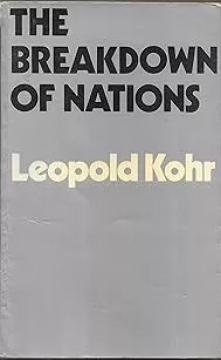
The Breakdown of Nations

The Breakdown of Nations

Leopold Kohr

This book shows that throughout history people who have lived in small states, where political leaders are accessible rather than remote, are happier, more peaceful, more creative and more prosperous.

This text is a masterpiece of social and political analysis. It presents the theory that the main cause of aggression and war is the excessive size leading to excessive power. According to this theory, given a critical dimension (number of size power) the (almost) inevitable consequence is violence. Kohr calls it the theory of the power of aggression or the theory of the power of social misery.

Dimensions
21.8 x 13.9 cm
Pages
244
Publisher
Christopher Davies Publishers, Swansea, 1957.
 
Latin alphabet. Paperback.
Language: English.

One copy is available

Condition:Used, very good condition
Damages or inconvenience notice:
  • Slight damage to the cover
  • Staines on the pages
 

Are you interested in another book? You can search the offer using our search engine or browse books by category.

You may also be interested in these titles

Teror narodu: Povijest OZNE, Titove političke policije

Teror narodu: Povijest OZNE, Titove političke policije

William Klinger

In the book, historian William Klinger investigates the origin and operation of OZNA - the brutal repressive apparatus of communist Yugoslavia, which monitored, imprisoned and liquidated political opponents.

Večernji list, 2014.
Croatian. Latin alphabet. Paperback.
7.34
Filozofija revolucije

Filozofija revolucije

Gamal Abdel Nasser

G. A. Nasser's Philosophy of Revolution is a political manifesto and ideological program of the Egyptian Revolution of 1952. In it, Nasser explains the motives of the revolution, the role of Egypt in the Arab and African world, and the vision of Arab nati

Džepna knjiga, 1956.
Serbian. Latin alphabet. Paperback.
9.56
Doživljaji i putovanja do slobode

Doživljaji i putovanja do slobode

Vladimir Novak

The autobiographical work of Croatian communist activist Vladimir Novak, a survivor of the Ustasha camps, follows his memories of resistance to fascism during World War II.

August Cesarec, 1979.
Croatian. Latin alphabet. Hardcover with dust jacket.
8.266.20
Povratak iz Gulaga: Tajni referat Hruščova

Povratak iz Gulaga: Tajni referat Hruščova

Karlo Štajner

A sequel to his memoir 7000 Days in Siberia, in which he describes his twenty-year imprisonment in Soviet gulags. The book delves into his experiences in the camps, providing additional insights into Steiner's life and reflections on communist ideals.

Globus, 1986.
Croatian. Latin alphabet. Hardcover with dust jacket.
10.76 - 11.24
Zaraćeno poraće: Konfliktni i konkurentski narativi o stradanju i iseljavanju Talijana Istre

Zaraćeno poraće: Konfliktni i konkurentski narativi o stradanju i iseljavanju Talijana Istre

Franko Dota

The book analyzes how conflicting historical narratives about the suffering and mass emigration of Italians from Istria and Rijeka developed in Croatia and Italy after World War II (1943–1956), debunking myths and encouraging an empathetic approach to the

Srednja Europa, 2010.
Croatian. Latin alphabet. Paperback.
11.32
Komunisti Jugoslavije 1919-1979.

Komunisti Jugoslavije 1919-1979.

Pero Morača, Stanislav Stojanović

The book provides an overview of the history of the Communist Party of Yugoslavia (KPJ) from its founding to the late 1970s, emphasizing its role in the revolution, self-government, and construction of Yugoslavia, with an ideologically colored perspective

Eksportpres, 1979.
Serbian. Latin alphabet. Hardcover with dust jacket.
11.98