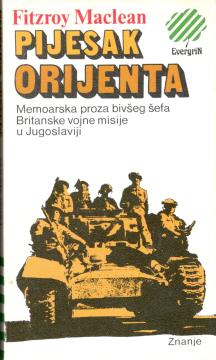
Pijesak Orijenta

Pijesak Orijenta

Fitzroy MacLean

The memoir The Sands of the Orient (1949), part of the autobiographical work of the British diplomat, soldier and writer Fitzroy Maclean (1911–1996), describes his adventures in the diplomatic service and World War II.

Divided into three parts, the book focuses on "Eastern Approaches" – trips to the restricted zones of the USSR, Iran and Africa, and the mission in Yugoslavia. Maclean, the inspiration for James Bond, writes vividly, with humor and irony, celebrating adventure and geopolitical intrigue.

The first part takes you to Moscow in 1937, where Maclean, a young diplomat, observes the Stalinist purges and famine in Ukraine. Dissatisfied with diplomatic life, he travels around Central Asia under the guise of a journalist: he visits Samarkand, Bukhara and Kashgar, risking arrest by the NKVD. He meets nomadic tribes, describes exotic bazaars and conflicts between Marxism and Islam, emphasizing the contrast between Soviet propaganda and poverty. These "forbidden" trips symbolize his thirst for freedom and criticism of totalitarianism.

The second part goes to war: in 1941, Maclean joins the army and joins the SAS (Special Air Service) in North Africa. As a commander, he leads airborne attacks on Rommel's lines - they destroy the air forces at Benghazi and Tobruk, racing through the desert with minimal equipment. He describes tense night missions, losses and camaraderie, mocking bureaucracy. Then follows a mission in Iran in 1943: with a group of officers, he organizes the occupation of Tehran against pro-Nazi forces, meeting the Shah and British allies, and risking assassination.

The third part, the most famous, deals with Yugoslavia: as head of the British mission, Maclean parachutes into Durmitor in 1943-1944, joining Tito's partisans. He lives in caves, fights against Chetniks and Germans, organizing air supplies. He describes Tito as a charismatic leader, but also the brutality of war - massacres, famine and ideological conflicts. His role was crucial for Allied support for the partisans, changing the course of the war in the Balkans.

Original title
Eastern Approaches
Translation
Konstantin Miles
Editor
Zlatko Crnković
Graphics design
Alfred Pal
Dimensions
20 x 12 cm
Pages
167
Publisher
Znanje, Zagreb, 1981.
 
Latin alphabet. Paperback.
Language: Croatian.

One copy is available

Condition:Unused
 

Are you interested in another book? You can search the offer using our search engine or browse books by category.

You may also be interested in these titles

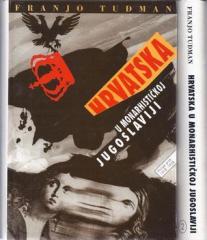
Hrvatska u monarhističkoj Jugoslaviji I-II

Hrvatska u monarhističkoj Jugoslaviji I-II

Franjo Tuđman
Hrvatska sveučilišna naklada, 1993.
Croatian. Latin alphabet. Hardcover.
The book consists of two volumes
19.75
Izgubljena orijentacija

Izgubljena orijentacija

Radovan Radonjić

"Lost Orientation" by Radovan Radonjić, published in 1985, represents a philosophical and sociological reflection on the then Yugoslav society and the crisis of socialist identity.

Radnička štampa, 1985.
Serbian. Latin alphabet. Paperback.
6.985.24
U Titovim pandžama (Svjedočanstva)

U Titovim pandžama (Svjedočanstva)

Vladislav Musa

The content of the book is real and experienced in the enslaved homeland, in the dictatorship and Tito's prisons.

Vlastita naklada, 1973.
Croatian. Latin alphabet. Paperback.
27.36
Sudbonosni podvig Jugoslavije: Podsjećanje na historijsko NE staljinizmu, događaj koji je opredijelio budućnost Jugoslavije

Sudbonosni podvig Jugoslavije: Podsjećanje na historijsko NE staljinizmu, događaj koji je opredijelio budućnost Jugoslavije

Raif Dizdarević

The book by Raif Dizdarević, one of the last living actors of Yugoslav diplomacy, presents his reconstruction of the most fateful moment of post-war Yugoslavia – the split with Stalin and the Informburo in 1948–1953.

Udruženje za modernu historiju (UMHIS), 2018.
Croatian. Latin alphabet. Paperback.
23.58
KPJ-SKJ u izgradnji oružanih snaga i ONO

KPJ-SKJ u izgradnji oružanih snaga i ONO

This book deals with the topic of the construction of the armed forces during the period of Yugoslavia.

Vojnoizdavački zavod, 1979.
Croatian. Latin alphabet. Hardcover with dust jacket.
9.987.49
Živjeti u Hrvatskoj: Zapisci iz nepovrata 1900 - 1941.

Živjeti u Hrvatskoj: Zapisci iz nepovrata 1900 - 1941.

Horvat
Josip Horvat

The book represents a personal chronicle of Croatian history in the first half of the 20th century, written by Josip Horvat with the intention of documenting the social, political, and cultural changes that shaped Croatia between 1900 and 1941.

Sveučilišna naklada Liber (SNL), 1984.
Croatian. Latin alphabet. Hardcover with dust jacket.
17.24