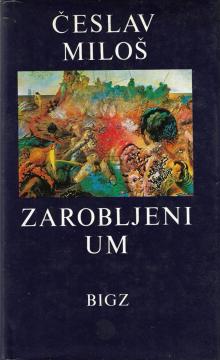
Zarobljeni um

Zarobljeni um

Czesław Miłosz

A cult essay study by Nobel laureate Czesław Miłosz on intellectuals and totalitarianism. The work brilliantly dissects the mechanisms by which Stalinism and ideology enslave human consciousness.

“The Captive Mind” is the most famous and world-renowned essay by Polish writer and Nobel Prize winner Czesław Miłosz. Published in 1953, this book represents one of the deepest and most lucid analyses of totalitarianism and the mentality of intellectuals under the auspices of Soviet communism and Stalinism in Eastern Europe.

Using powerful literary metaphors and deep psychological insight, Miłosz explores why numerous gifted artists and thinkers voluntarily accepted dogmatism and censorship, adapting their spirit to the demands of the Party. Instead of dry politics, the author dissects moral compromises, fear, opportunism and processes of internal adaptation in a system that tramples on individuality through the depictions of four fictional characters (under whom the writer’s real contemporaries and colleagues hide).

This capital work of political philosophy and sociology of culture is an indispensable read that offers lasting answers about the mechanisms of manipulation of consciousness, freedom of creativity and resistance of the spirit. A must-have title in the library of every connoisseur of serious literature.

Original title
Zniewolony umysł
Translation
Petar Vujičić
Editor
Jovan Radulović
Illustrations
Salvador Dali
Graphics design
Rade Rančić
Dimensions
21 x 13 cm
Pages
336
Publisher
BIGZ, Beograd, 1987.
 
Distribution: 10,000 copies
 
Latin alphabet. Hardcover with dust jacket.
Language: Serbian.
ISBN
8-61-300113-0

Two copies are available

Copy number 1

Condition:Used, excellent condition

Copy number 2

Condition:Used, excellent condition
 

Are you interested in another book? You can search the offer using our search engine or browse books by category.

You may also be interested in these titles

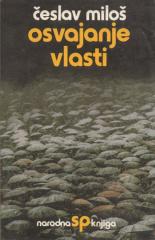
Osvajanje vlasti

Osvajanje vlasti

Czesław Miłosz

A brilliant political novel by Nobel Prize winner Czesław Miłosz that dissects the establishment of communist rule in Poland at the end of World War II. Through the fates of the characters, it depicts moral dilemmas and collaboration.

Narodna knjiga, 1983.
Croatian. Latin alphabet. Paperback with dust jacket.
11.32
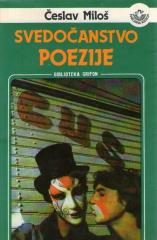
Svedočanstvo poezije

Svedočanstvo poezije

Czesław Miłosz

A collection of lectures by Czesław Miłosz that explores the role of the poet in a world marked by historical tragedies and totalitarianisms, emphasizing the ethical responsibility of art towards reality.

Narodna knjiga, 1985.
Serbian. Latin alphabet. Paperback with dust jacket.
9.36
Poezija i zbilja

Poezija i zbilja

Johann Wolfgang Goethe

Goethe's greatest autobiographical prose, written between 1811 and 1833, covers his life from his birth in 1749 in Frankfurt to 1775, when he went to Weimar at the invitation of Duke Karl August.

Matica hrvatska, 1953.
Croatian. Latin alphabet. Hardcover with dust jacket.
18.42
Sol, ovce i kamenje

Sol, ovce i kamenje

Magdaléna Platzová

A fresh, uninhibited literary view of Dalmatia. Four stories about Dalmatia told in the manner of the best pages of Czech literature. Bringing to life the scents of salt and sea, the author writes vivid prose full of color and flavor.

Fraktura, 2006.
Croatian. Latin alphabet. Paperback.
8.54
Primicanje katastrofa: Propasti koje prijete našem svijetu

Primicanje katastrofa: Propasti koje prijete našem svijetu

Isaac Asimov

A popular science work in which Asimov, combining scientific rigor with a lucid style, explores possible threats to the survival of humanity, systematizing disasters according to their nature and probability.

August Cesarec, 1981.
Croatian. Latin alphabet. Hardcover with dust jacket.
7.46
Prvi kontakt

Prvi kontakt

Arthur C. Clarke

Zoran Živković, an excellent connoisseur of science fiction, made a selection of Clarke's best stories with the motif of first contact and wrote an extensive text in which he interprets them in detail.

NIRO Književne novine, 1985.
Serbian. Latin alphabet. Paperback.
5.64 - 5.72