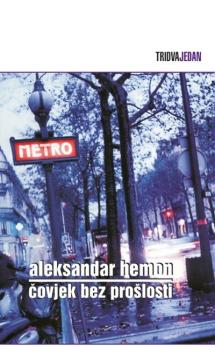
Čovjek bez prošlosti

Čovjek bez prošlosti

Aleksandar Hemon

The most convincing part of this novel is certainly the one in Sarajevo, but also in other parts of the novel, Aleksandar Hemon connects interesting motives and observations in a breakneck fashion into a unique novel construction.

At the same time, this autobiographical mystification in which Hemon narrates the life of his alter ego Jozef Pronek is thematically based to a large extent on Sarajevo, Bosnia and SFR Yugoslavia, and Yugoslavia from those times when it was not yet interesting to CNN.

Pronek's biography is told in the first person by his friends and/or eyewitnesses, and three separate parts can be distinguished. In the first, the narrator narrates about Pronek growing up in Sarajevo in the eighties, in the second, Pronek as a member of the Ukrainian minority finds himself on a scholarship in Kiev during the anti-democratic coup in Moscow, and in the third, Pronek is an immigrant to the USA who collects donations from house to house for Greenpeace. The novel ends with a Borgesian novel about the Russian "white" officer Yevgeni Pick and his adventures in Harbin and Shanghai at the beginning of the century.

Original title
Nowhere man
Translation
Luka Bekavac
Editor
Nenad Rizvanović
Dimensions
20 x 12 cm
Pages
255
Publisher
VBZ, Zagreb, 2004.
 
Latin alphabet. Paperback.
Language: Croatian.
ISBN
9-53-201377-6

One copy is available

Condition:Used, excellent condition
 

Are you interested in another book? You can search the offer using our search engine or browse books by category.

You may also be interested in these titles

Aurorin poticaj

Aurorin poticaj

Erich Hackl

The work is based on a true event that occurred in Spain in 1933: Aurora Rodriguez killed her daughter Hildegart, a famous fighter for women's emancipation and a cult figure on the political scene of the time.

Mladost, 1990.
Croatian. Latin alphabet. Hardcover with dust jacket.
4.983.74
Klatno

Klatno

György Konrád

Pendulum draws an inner map of the adventure of self-disclosure - of one's own inclinations, fears, desires, Love - one's own habitus, revealing, as never before, the secrets of the writer's workshop.

Kulturni centar Novog Sada, 2010.
Serbian. Latin alphabet. Paperback.
6.24
Usta puna zemlje

Usta puna zemlje

Branimir Šćepanović

The novel "Usta puna zemlje" (1970), the masterpiece of the Serbian writer Branimir Šćepanović, is a psychologically in-depth explorer of the limits of the human soul, solitude and existential freedom, reminiscent of Kafka and Camus.

BIGZ, 1987.
Serbian. Latin alphabet. Paperback.
3.98
Pripovetke iz levog i desnog džepa

Pripovetke iz levog i desnog džepa

Karel Čapek

These stories deal with different topics, although most deal with different criminal acts, from fraud and fortune-telling to marriage fraud and murder.

Jugoslavijapublik, 1980.
Croatian. Latin alphabet. Hardcover.
5.22
Andrićeva lestvica užasa

Andrićeva lestvica užasa

Svetislav Basara

A Serbian writer known for his satirical novels, Andrić's Ladder of Horrors dissects the Balkan mentality through a parable of Yugo-nostalgia and national myths. The title alludes to Ivo Andrić as a litmus test for criticism – Balkans claim him or reject

24 sata, 2021.
Serbian. Latin alphabet. Paperback.
11.56
Proces

Proces

Franz Kafka

Kafka wrote The Process between 1914 and 1915, published posthumously in 1925. The novel is unfinished but with an added final chapter by Max Brod. Edition with a foreword by B. Živojinović and an afterword by Walter Killi.

BIGZ, 1990.
Serbian. Latin alphabet. Paperback.
4.26