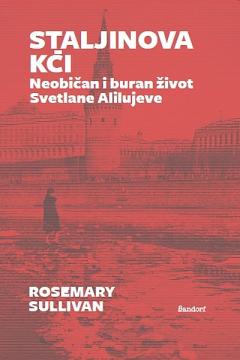
Staljinova kći: neobičan i buran život Svetlane Alilujeve

Staljinova kći: neobičan i buran život Svetlane Alilujeve

Rosemary Sullivan

Rosemary Sullivan managed to outline the incredible personality of Svetlana Alliluyeva, Stalin's daughter who found the moral strength and consistency to resist the manipulative patterns of the dictator's mind and the machinery that wholeheartedly served

"You should not complain about your fate, although I regret that my mother did not marry a carpenter", said Svetlana Aliluyeva, daughter of Joseph Visarionovich Stalin, in an interview for the Independent in March 1990. In her truly unusual and stormy life, full of incredible twists and turns that greatly surpass the plots of spy bestsellers, the short twentieth century is mirrored, the center of which is the conflict between two ideologically and militarily opposed blocs, a conflict in which on the one hand she was treated as "state property" and on the other misused for political and media manipulations. As a little girl, whom her father affectionately called her "sparrow", she ran around the Kremlin, unaware that those cheerful men stroking her hair were organizing mass deportations and murders, whose victims included her closest relatives. Her mother's suicide and the knowledge of Stalin's crimes left an indelible mark on her soul. Having defected to the West in 1967, she got rich selling her memoirs and became world famous; she died alone, poor and anonymous. Trying to escape from "her fate", she tried to find peace in numerous marriages, changing dozens of addresses on several continents. To no avail. But what fascinates in this masterfully narrated biography is the willpower of a fragile and confused human being to oppose both the gruesome family legacy and the monstrous visible and invisible power centers.

Original title
Stalin’s Daughter
Translation
Marko Gregorić
Editor
Darko Milošić
Graphics design
Nikša Eršek
Dimensions
21 x 15 cm
Pages
609
Publisher
Sandorf, Zagreb, 2017.
 
Latin alphabet. Paperback.
Language: Croatian.
ISBN
978-9-53351-033-0

No copies available

The last copy was sold recently.
 

Are you interested in another book? You can search the offer using our search engine or browse books by category.

You may also be interested in these titles

Komunisti Jugoslavije 1919-1979.

Komunisti Jugoslavije 1919-1979.

Pero Morača, Stanislav Stojanović

The book provides an overview of the history of the Communist Party of Yugoslavia (KPJ) from its founding to the late 1970s, emphasizing its role in the revolution, self-government, and construction of Yugoslavia, with an ideologically colored perspective

Eksportpres, 1979.
Serbian. Latin alphabet. Hardcover with dust jacket.
11.988.39
Doživljaji i putovanja do slobode

Doživljaji i putovanja do slobode

Vladimir Novak

The autobiographical work of Croatian communist activist Vladimir Novak, a survivor of the Ustasha camps, follows his memories of resistance to fascism during World War II.

August Cesarec, 1979.
Croatian. Latin alphabet. Hardcover with dust jacket.
8.266.20
Ljubljana u borbi 1941–1945: Zbornik sećanja

Ljubljana u borbi 1941–1945: Zbornik sećanja

The collection brings together the memories of participants in the national liberation struggle in Ljubljana during World War II. The collection contains personal testimonies, which provide insight into the everyday life, struggle and sacrifices of the in

Vojnoizdavački zavod, 1978.
Serbian. Latin alphabet. Hardcover with dust jacket.
9.76
Istorija Pariske komune 1871.

Istorija Pariske komune 1871.

Prosper-Olivier Lissagaray

Prosper-Olivier Lissagaray, a French journalist, politician, and participant in the Paris Commune, wrote History of the Paris Commune in 1871 as a detailed account of the events that marked the first workers' government in history.

Mladost, 1946.
Serbian. Latin alphabet. Hardcover.
8.265.78
Radni logor Valpovo 1945.-1946.: dokumenti

Radni logor Valpovo 1945.-1946.: dokumenti

Vladimir Geiger

The Valpovo labor camp (1945–1946) was the largest camp for Volksdeutschers in Croatia after World War II. About 4,000 Germans and Austrians were interned; at least 1,074 died, mostly from hunger, disease, and exhausting labor.

Njemačka zajednica podunavskih Švaba u Hrvatskoj, 1999.
Croatian. Latin alphabet. Hardcover.
27.34
Sam protiv njih

Sam protiv njih

Roman Leljak

A non-fiction work by a Slovenian investigator of the UDB archives. The author, a former KOS employee, left the army after learning about the crimes of the Yugoslav army during the war and the post-war period, and dedicated himself to exposing the secret

Vlastita naklada, 1990.
Croatian. Latin alphabet. Paperback.
16.42