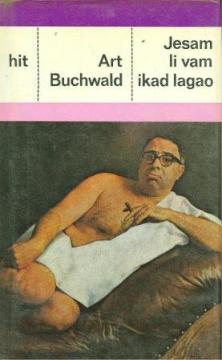
Jesam li vam ikad lagao?

Jesam li vam ikad lagao?

Art Buchwald

Have I Ever Lied to You? by Art Buchwald is a collection of satirical stories and newspaper columns that humorously comment on politics, the media, and everyday life. He uses humor to expose the absurdities of contemporary society.

Have I Ever Lied to You? is a book by American humorist and journalist Art Buchwald, one of the most famous political satirists of the 20th century. The work brings together a series of humorous texts, essays, and columns in which the author comments on political events, social phenomena, and human habits in a recognizable way.

Instead of a single plot and permanent characters, the book consists of a series of independent texts. In them, Buchwald invents seemingly ordinary situations that gradually develop into absurd and comic scenes. He often uses fictional politicians, civil servants, journalists, and citizens in order to ridicule bureaucracy, political propaganda, the excessive seriousness of public life, and numerous social paradoxes through their conversations and actions.

American politics in the 1960s occupies a special place, but the author's remarks transcend specific time and place. His topics include the influence of the media, the relationship of the government to citizens, the consumer mentality, international relations, and everyday human weaknesses. Buchwald does not criticize openly and aggressively, but uses irony, exaggeration and humor to make the reader think.

The characters in his stories often represent types of people – ambitious politicians, confused citizens, bureaucrats or journalists – and serve as a means of depicting broader social problems. This is precisely why humor comes from recognizing real phenomena behind literary caricature.

Thanks to its witty style, short form and sharp observations, Have I Ever Lied to You? remains an interesting work that shows how humor can be an effective means of social criticism and how behind laughter there is often a serious commentary on the world in which we live.

Original title
Have I Ever Lied to You?
Translation
Nikola Kršić
Editor
Zlatko Crnković
Graphics design
Alfred Pal
Dimensions
19.5 x 12 cm
Pages
220
Publisher
Znanje, Zagreb, 1981.
 
Latin alphabet. Hardcover with dust jacket.
Language: Croatian.

Multiple copies are available

Copy number 1

Condition:Used, excellent condition

Copy number 2

Condition:Used, excellent condition
Damages or inconvenience notice:
  • A message of a personal nature

Copy number 3

Condition:Used, excellent condition
 

Are you interested in another book? You can search the offer using our search engine or browse books by category.

You may also be interested in these titles

Amandino vjenčanje

Amandino vjenčanje

Jenny Colgan

A romantic comedy about friendship, love, and the chaotic attempts to save a good man from a bad marriage. A chick-lit hit, it reminds us that friendship saves more than any plan, and love comes unexpectedly.

Znanje, 2001.
Croatian. Latin alphabet. Paperback.
5.364.02
Goli kruh

Goli kruh

Mohamed Choukri

Mohamed Choukri's novel Bare Bread is a powerful autobiographical story about poverty, hunger and the struggle for dignity in Morocco in the mid-20th century.

Znanje, 1988.
Croatian. Latin alphabet. Hardcover with dust jacket.
3.64
Dok vrijeme prolazi

Dok vrijeme prolazi

Michael Walsch

Michael Walshs As Time Goes By setzt die Geschichte des Films Casablanca fort und erweitert sie. Er verfolgt das Schicksal von Rick, Ilsa und anderen Figuren während des Zweiten Weltkriegs, geprägt von Liebe, Krieg und gefährlichen Missionen.

Znanje, 1999.
Croatian. Latin alphabet. Paperback.
4.36
Put u Jajce

Put u Jajce

Edvard Kocbek

In „Put u Jajce“ gibt Edvard Kocbek persönliche und politische Zeugnisse über Schlüsselmomente der jugoslawischen Geschichte. Das Buch basiert auf Kocbeks Erinnerungen an den Zweiten Weltkrieg, insbesondere an die Reise nach Jajce im Jahr 1943.

Znanje, 1978.
Croatian. Latin alphabet. Hardcover with dust jacket.
8.38
Made in U.S.A.

Made in U.S.A.

Goran Tribuson

Stellen Sie sich das Zagreb der 1980er Jahre vor, wo sich hinter den grauen Fassaden der Wohnhäuser eine Traumwelt des Wilden Westens verbirgt – Hollywood, Freiheit und endlose Möglichkeiten. Tribuson, ein Meister der kroatischen Prosa, verbindet hier Gen

Znanje, 1986.
Croatian. Latin alphabet. Hardcover with dust jacket.
5.72
Zajednička kupka

Zajednička kupka

Ranko Marinković

Das Gemeinschaftsbad ist eine Art Rekapitulation – darin werden Marinkovićs obsessive Motive (Demütigung, Betrug und Tod) auf direkteste und unmittelbarste Weise thematisiert. In einer seiner Schichten ist der Roman auch eine Metapher für Literatur, eine

Znanje, 1980.
Croatian. Latin alphabet. Hardcover with dust jacket.
8.56