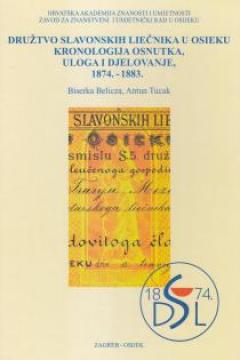
Družtvo slavonskih liečnika u Osieku : kronologija osnutka, uloga i djelovanje, 1874. - 1883.
Biserka Belicza, Antun Tucak
Shaping of the doctor's professional identity in the second half of the 19th century resulted in the establishment of the Society Slavonian doctors in Osijek in 1874.
Today's successor to that "Society" is the Croatian Medical Association. Choir – Osijek Branch. "Society" is for those times an equal counterpart to the simultaneously established Medical Association Kr. of Croatia and Slavonia with headquarters in Zagreb.
In his major work from 1910, Josip Bösendorfer provides an overview of Slavonian history with an emphasis on the past of the counties (Križevci, Virovitica, Požega, Baranja, Vukovo, Srijem) and the city of Osijek in the Middle Ages and the modern era.
Naklada Radoslava Bačića, 1910.
Croatian. Latin alphabet. Hardcover.
86.42 €
World War II • Croatian history • Yugoslavia • Serbian History • Political-historical essays
The generation to which Konstantinović belonged managed to reach an agreement and, had it not been for the Second World War, was on the threshold of establishing liberal democracy in Yugoslavia, whose supporter Konstantinović was.
Agencija Mir, 1998.
Serbian. Latin alphabet. Hardcover.
39.99 €
Diplomacy • Politicology • Law • Documents and records • Homeland war • Croatian history
The collection brings together scholarly works on key political, legal, and diplomatic processes that led to the creation of the Croatian state in 1991, analyzing the decisions, actors, and international circumstances crucial to independence.
Hrvatska akademija znanosti i umjetnosti (HAZU), 2015.
Croatian. Latin alphabet. Paperback.
17.26 €
Facsimile editions • Croatian history • Modern Age • History of Bosnia and Herzegovina • Middle Ages • Serbian History
The book represents a novelty not only in Istrian, but also in Croatian historiography. Namely, the clothing culture in the region of Istria in the early modern period has not yet been analyzed at all, and for the region of Dalmatia only sporadically.
In his work Starohrvatska seoska zajednica (The Old Croatian Village Community) (1957), Miho Barada analyzes the social and agrarian organization of early medieval Croatian villages, their institutions, ownership relations, and common land based on origin
Jugoslavenska akademija znanosti i umjetnosti (JAZU), 1957.