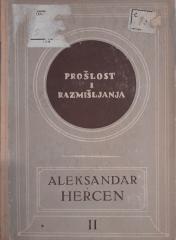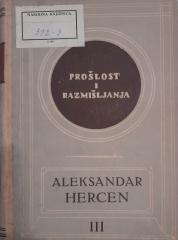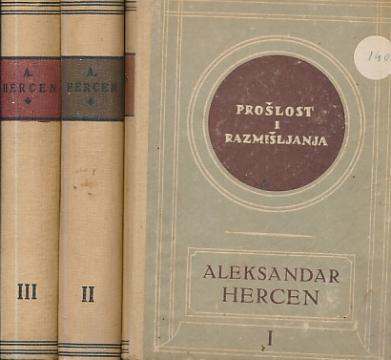
Prošlost i razmišljanja

Prošlost i razmišljanja

Aleksandar Hercen

Herzen writes an autobiography and a chronicle of the 19th century in The Past and Reflections. From childhood in Moscow, through exile in Russia to life in emigration. A deep analysis of society and personal fate - a masterpiece of Russian memoirs.

Past and Reflections (1852–1870) by Alexander Herzen is one of the greatest works of Russian and world memoir. The first three volumes (parts) cover Herzen's life from his birth in 1812 to the end of the 1840s, that is, until his departure for emigration.

The first part brings to mind a colorful childhood and youth in an aristocratic house in Moscow during Napoleon's invasion of 1812, his student days at Moscow University, the influence of the Decembrists, romantic ideas, and early socialism. The second and third parts describe his arrest in 1834 for "free-thinking" conversations, imprisonment, exile in Vyatka and Vladimir, marriage to his cousin Natalia Zakharina, and the intellectual circle of Moscow Westerners and Slavophiles.

Herzen masterfully combines a personal story with historical and philosophical reflections. The work is at once an autobiography, a novel, a political chronicle, and a philosophical reflection. It critically depicts the Russian autocratic system, serfdom, bureaucracy and hypocrisy of high society, but also the disappointment with the Western revolutions (1848).

The style is exceptionally lively, ironic, lyrical and analytical – Herzen paints portraits of his contemporaries (Belinsky, Ogarev, Bakunin and others) with the skill of a top novelist. The work is deeply humanistic: he defends the freedom of the individual, criticizes the dogmatism of any ideology and searches for the Russian path towards socialism based on the village commune (obščina).

The first three volumes end with a turning point – his departure for Europe, where Herzen will become the leading voice of the Russian emigration and the founder of the free Russian press (Kolokol). The book is the key to understanding the Russian 19th century, the emergence of the intelligentsia, revolutionary ideas and personalities that influenced Turgenev, Tolstoy, Lenin and many others.

Original title
Былое и думы
Translation
Josip Horvat
Dimensions
20 x 14 cm
Pages total
1494
Publisher
Matica hrvatska, Zagreb
 
Latin alphabet. Hardcover.
Language: Croatian.

The book consists of 3 volumes.

Dva višetomna primjerka su u ponudi.

Copy number 1
Discounted price : 29.9919.49
35% discount is valid until 12/31/26 11:59 pm

Prošlost i razmišljanja
Volume 1
Pages: 404
Condition:Used, very good condition
Damages or inconvenience notice:
  • Yellowed pages
  • Library stamp
  • Traces of patina
Prošlost i razmišljanja
Volume 2
Pages: 518
Condition:Used, very good condition
Damages or inconvenience notice:
  • Yellowed pages
  • Library stamp
  • Traces of patina
Prošlost i razmišljanja
Volume 3
Pages: 570
Condition:Used, very good condition
Damages or inconvenience notice:
  • Yellowed pages
  • Library stamp
  • Traces of patina

Copy number 2

Prošlost i razmišljanja
Volume 1
Pages: 404
Condition:Used, very good condition
Damages or inconvenience notice:
  • Traces of patina
Prošlost i razmišljanja
Volume 2
Pages: 518
Condition:Used, very good condition
Damages or inconvenience notice:
  • Traces of patina
Prošlost i razmišljanja
Volume 3
Pages: 570
Condition:Used, very good condition
 

Are you interested in another book? You can search the offer using our search engine or browse books by category.

You may also be interested in these titles

Savijest: Roman iz zbirke "Porodica Muratovih"

Savijest: Roman iz zbirke "Porodica Muratovih"

A. T. Šel. Mihajlov

"Conscience" (a novel about the Murat family) by A. T. Shel. Mikhailov is a psychological-moral novel about a Russian bourgeois family, internal conflicts, sin, responsibility and the voice of conscience. Popular Russian fiction in Croatian translation.

Tisak i naklada Lav. Weissa, 1920.
Croatian. Latin alphabet. Paperback.
9.36
Zločin i kazna

Zločin i kazna

Fjodor M. Dostojevski

After the impoverished student Raskolnikov commits a murder, justifying it with higher goals, his inner remorse, the psychological pressure of the investigator, and love subject him to a moral transformation.

Zora, 1952.
Croatian. Latin alphabet. Hardcover with dust jacket.
9.76
The Idiot

The Idiot

Fjodor M. Dostojevski
Wordsworth, 1996.
English. Latin alphabet. Paperback.
8.32
Kapetanova kći i druga djela

Kapetanova kći i druga djela

Aleksandar S. Puškin

The collection brings together Pushkin's lyrics and prose, from intimate poems to short stories and the novel The Captain's Daughter, showcasing the breadth of his talent, stylistic elegance, and enduring literary power.

Školska knjiga, 1974.
Croatian. Latin alphabet. Paperback.
6.24
Die Brüder Karamasow

Die Brüder Karamasow

Fjodor M. Dostojevski

The Brothers Karamazov is the last book by Russian writer Fyodor Mikhailovich Dostoevsky. Dostoevsky spent nearly two years writing The Brothers Karamazov, which was first published in serial form in the journal Russian Gazette, and was completed in late

Deutscher Bücherbund, 1976.
German. Latin alphabet. Hardcover with dust jacket.
8.54
Svjetska knjižnica, Sv. 3.

Svjetska knjižnica, Sv. 3.

Fjodor M. Dostojevski, Henryk Sienkiewicz

The World Library, Volume 3, edited and published by Iso Velikanović, contains excerpts from The Brothers Karamazov by F. M. Dostoevsky and Without Dogma by H. Sienkiewicz. Designed for self-binding of individual works.

Vlastita naklada, 1903.
Croatian. Latin alphabet. Paperback.
17.24