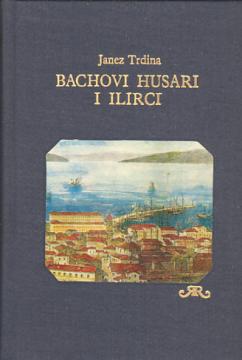
Bachovi husari i Ilirci: sjećanja iz mojih profesorskih godina u Hrvatskoj (1853–1867)

Bachovi husari i Ilirci: sjećanja iz mojih profesorskih godina u Hrvatskoj (1853–1867)

Janez Trdina

"Bach's Hussars and the Illyrians" is an autobiographical work by the Slovenian writer Janez Trdina, in which the author describes his experience as a professor in Croatia during the period of Bach's absolutism (1853–1867).

The book provides insight into the political and social climate of the time, marked by attempts at Germanization and centralization by the Viennese authorities.

Trdina describes in detail how foreign professors, often from Slovenia, the Czech Republic, Poland, and Tyrol, were sent to Croatian schools with the aim of suppressing the Croatian language and identity. These "Bach's hussars," as the author calls them, served as instruments of Viennese policy to suppress national consciousness among Croats.

Through his memoirs, Trdina also analyzes the relationship between the Slovenian and Croatian peoples, highlighting the similarities and differences in their reactions to political pressures. He pays special attention to the language issue, emphasizing the importance of preserving the mother tongue as the foundation of national identity.

Contents:

  • Foreword: Tone Potokar
  • Varaždin-Germanized Croatian gentlemen- first appearances of Bach's Hussars
  • In the center of Croatia – Illyrian priests, an example of patriotism, progress and character – The immense significance of Illyrianism for the spiritual growth and progress of the Croatian people
  • Bach wants to Germanize Croats with the help of bureaucracy
  • Croatia Rijeka and the Rijeka Gymnasium
  • Slavic and German professors of the Rijeka Gymnasium
  • Štefan Vidic, Principal of the Rijeka Gymnasium
  • School superintendent DR. Anton Jarc
  • Alphabetical list of personalities

Original title
Bachovi huzarji in Iliri
Translation
Tone Potokar
Dimensions
21 x 14 cm
Pages
290
Publisher
Grafički zavod Hrvatske (GZH), Zagreb, 1980.
 
Latin alphabet. Hardcover.
Language: Croatian.

No copies available

The last copy was sold recently.
 

Are you interested in another book? You can search the offer using our search engine or browse books by category.

You may also be interested in these titles

Anđelko Mijatović: Bleiburška tragedija i križni put hrvatskoga naroda godine 1945.

Anđelko Mijatović: Bleiburška tragedija i križni put hrvatskoga naroda godine 1945.

Anđelko Mijatović

The Bleiburg Tragedy and the Way of the Cross of the Croatian People in 1945 is a historical-documentary work by Croatian historian and university professor Anđelko Mijatović.

HSK, 2007.
Croatian. Latin alphabet. Paperback.
6.62
Kronika o glazbenoj i dramskoj djelatnosti u Belišću 1890.-1990.

Kronika o glazbenoj i dramskoj djelatnosti u Belišću 1890.-1990.

Dragutin Gibičar
Gradsko poglavarstvo, 2008.
Croatian. Latin alphabet. Paperback.
9.98
Vodič kroz grad Osijek

Vodič kroz grad Osijek

An important document reflecting the state of the city immediately after World War II. The guide served as a practical tool for orientation and informing citizens and visitors about the urban layout and infrastructure of the city at that time.

Gradski N. O., Građevinski odjel u Osijeku, 1946.
Croatian. Latin alphabet. Paperback.
64.28
Komunizam i čovjek: Odnos vlasti i pojedinca u Hrvatskoj (1958.–1972.)

Komunizam i čovjek: Odnos vlasti i pojedinca u Hrvatskoj (1958.–1972.)

Josip Mihaljević

Josip Mihaljević's book analyzes the relationship between the government and the individual in communist Croatia (1958–1972), through repressive mechanisms, ideological pressures, and restrictions on personal freedom in the socialist system.

Hrvatski institut za povijest, 2016.
Croatian. Latin alphabet. Hardcover.
17.26
Stepinac

Stepinac

Zvonimir Despot, Jadranka Jureško-Kero, Darko Pavičić, Ljiljana Risek, Silvije Tomašević
Večernji list, 2012.
Croatian. Latin alphabet. Paperback.
8.56 - 9.38
Zaraćeno poraće: Konfliktni i konkurentski narativi o stradanju i iseljavanju Talijana Istre

Zaraćeno poraće: Konfliktni i konkurentski narativi o stradanju i iseljavanju Talijana Istre

Franko Dota

The book analyzes how conflicting historical narratives about the suffering and mass emigration of Italians from Istria and Rijeka developed in Croatia and Italy after World War II (1943–1956), debunking myths and encouraging an empathetic approach to the

Srednja Europa, 2010.
Croatian. Latin alphabet. Paperback.
11.329.06