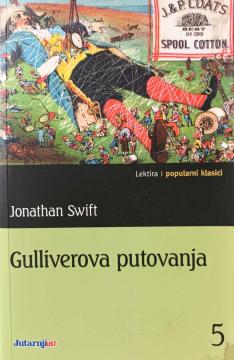
Gulliverova putovanja

Gulliverova putovanja

Jonathan Swift

Lemuel Gulliver experiences four incredible journeys to fantastic lands: Lilliput, Brobdingnag, Laputa, and the land of the Houyhnhnms. Swift's ingenious satire on human nature, politics, science, and society.

Gulliver's Travels (1726) is one of the greatest satirical works of world literature. Although often mistaken for a children's book, it is a sharp, cynical and deeply pessimistic critique of human nature and society in the 18th century.

The novel is divided into four parts, narrated by the ship's doctor and traveler Lemuel Gulliver. In the first part, Gulliver ends up in Lilliput, a land of tiny people only 6 inches tall. There, Swift satirizes English politics, court intrigue, senseless wars (e.g., the dispute over which side to break an egg on) and the vanity of the powerful.

In the second part, Gulliver arrives in Brobdingnag, a land of giants. Now tiny himself, he is faced with the opposite perspective – the human body and customs become disgusting and grotesque when viewed up close. The King of Brobdingnag concludes that humans are the most harmful little reptiles on Earth.

The third part takes him to the flying island Laputa and other strange lands, where he ridicules useless science, abstract philosophy and academic nonsense (projects to extract sunlight from cucumbers, etc.).

The fourth and most radical part takes him among the Houyhnhnms – noble, intelligent horses – and Yahoos, dirty, greedy and violent animal-men. Gulliver becomes completely disillusioned with his own kind and eventually no longer wants to live among people.

Swift uses fantastic adventures as a mirror in which he exposes human stupidity, corruption, wars, colonialism, religious conflicts and vanity. The style is seemingly simple and adventurous, but beneath the surface it hides bitter, dark humor and a deep skepticism towards humanity.

Original title
Gulliver's Travels
Translation
Ivo Velikanović
Illustrations
Corbis
Graphics design
Halid Malla
Dimensions
19.5 x 12.8 cm
Pages
255
Publisher
Jutarnji list, Zagreb, 2004.
 
Latin alphabet. Paperback.
Language: Croatian.
ISBN
9-53-716035-1

Multiple copies are available

Copy number 1

Condition:Used, excellent condition

Copy number 2

Condition:Used, excellent condition

Copy number 3

Condition:Unused

Copy number 4

Condition:Unused
 

Are you interested in another book? You can search the offer using our search engine or browse books by category.

You may also be interested in these titles

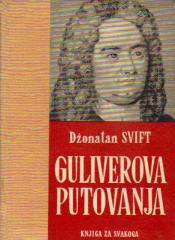
Guliverova putovanja

Guliverova putovanja

Jonathan Swift
Branko Đonović, 1963.
Serbian. Latin alphabet. Hardcover with dust jacket.
3.98 - 3.99
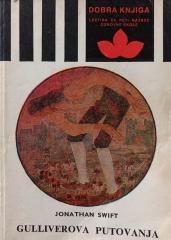
Guliverova putovanja

Guliverova putovanja

Jonathan Swift

Gulliver cannot imagine his life without traveling, he is an adventurer and his goal is not to learn or find out anything, but to experience numerous adventures.

Školska knjiga, 1975.
Croatian. Latin alphabet. Paperback.
2.98
Povjestice

Povjestice

August Šenoa

The collection includes the following short stories: "The Shoemaker and the Devil", "The Stone Wedding", "The House of the Kug", "The Fall of Venice" and "The Death of Petar Svačić", with which this famous writer occupies a special place in the history of

Profil International, 2008.
Croatian. Latin alphabet. Hardcover.
13.26
Olfi među ženama

Olfi među ženama

Christine Nöstlinger

The novel humorously and warmly depicts the everyday life of a fourteen-year-old boy, Olfi (Wolfgang), the only man in a house full of women. A classic of Austrian children's literature, it is often read in elementary school.

Znanje, 2009.
Croatian. Latin alphabet. Paperback.
9.76 - 9.78
Povjestice

Povjestice

August Šenoa

This edition brings a selection of Šenoa's most famous cycle – epic-lyric poems-stories from "Povjestica". They are written in verse, with rhymes and rhythm, like old folk songs that are easy to remember and read aloud. Reading for 6th grade.

Zagrebačka stvarnost, 2003.
Croatian. Latin alphabet. Hardcover.
6.74
Šaljive narodne pripovijetke

Šaljive narodne pripovijetke

This popular reading edition of Zagrebačka stvarnosti brings a selection of the most entertaining and famous Croatian folk humorous stories - those that have been told by the hearth for centuries, and today are part of the required reading for elementary

Zagrebačka stvarnost, 2002.
Croatian. Latin alphabet. Hardcover.
7.86