Bhagavad-Gita: Pesma gospodnja

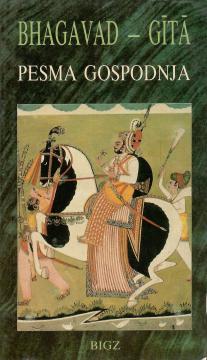
Bhagavad-Gita: Pesma gospodnja

Marković's translation of the Bhagavad-Gita (1980) is the first rendition of this philosophical-religious epic in the Serbian language. Before that (in 1929), Pavle Jevtić translated the Gita into prose.

The Bhagavad Gita is a poetic work composed of 18 cantos and 700 stanzas. The author of Bhagavd Gita is Dvaipayana Vyasa (Veda Vyas). The poem describes a conversation between the Supreme Lord Krishna and the warrior Arjuna on the battlefield. The work was placed at the beginning of the sixth book (Bhishmaparavan) as one of the episodes of the great Indian epic Mahabharata. Orthodox Hindus consider the contents of the Bhagavad Gita to be a faithful representation of the teachings of Sri Krishna, who is said to have died around 3102 BCE. Therefore, the teachings contained in the Bhagavad Gita would have originated from that ancient time. However, cultural-historical, linguistic and stylistic reasons, along with signs that the book changed its form over time, indicate that the work in its current form and size was created around 300 BC. The Bhagavad Gita was written in Sanskrit and has been translated into almost all languages ​​of the world. Making a great contribution to Croatian translated literature, the Bhagavad Gita was sung into Croatian with great artistic effort by Đuro Robotić. One of the most significant translations of the Bhagavad Gita in the Croatian language is that by Ankica Franjić under the title Bhagavd Gita as it is, based on the model of the English edition of the Bhaktivedanta book trust with translations and comments by Bhaktivedanta Swami Prabhupada, who is described by the Britannica encyclopedia as one of the most significant representatives of Indian spiritual thought .

Translation
Miroslav Marković
Graphics design
Silvano Jović
Dimensions
18 x 10.5 cm
Pages
168
Publisher
BIGZ, Beograd, 1989.
 
Latin alphabet. Paperback.
Language: Serbian.

No copies available

The last copy was sold recently.
 

Are you interested in another book? You can search the offer using our search engine or browse books by category.

You may also be interested in these titles

Pančatantra

Pančatantra

The Panchatantra was conceived as a kind of manual for rulers, in which popular wisdom is combined with philosophy, psychology and politics, and all of this is presented in a simple and elegant style of superior literature.

LOM, 2008.
Serbian. Cyrillic alphabet. Paperback.
9.76
Brodolom

Brodolom

Rabindranath Tagore

The novel Wreck (1906), the work of an Indian Nobel laureate, is a story set in colonial India, exploring themes of love, identity, tradition, and moral dilemmas through a complex plot full of unexpected twists.

Svjetlost, 1963.
Serbian. Latin alphabet. Hardcover.
4.36
Hiljadu lotosa

Hiljadu lotosa

Vesna Krmpotić

A Thousand Lotuses (first edition 1971, several reprints) represents the first comprehensive anthology of Indian literature in South Slavic languages, covering the period from the most ancient times (Vedic period) to the 17th century.

Nolit, 1971.
Croatian. Latin alphabet. Hardcover with dust jacket.
8.24
Žena koja je slikala kanom

Žena koja je slikala kanom

Alka Joshi

"The Woman Who Painted with Henna" is the debut novel of Indian-American author Alka Joshi, the first part of the Jaipur trilogy. The novel has been praised for its authentic portrayal of Rajasthani culture and the universal theme of female emancipation.

Mozaik knjiga, 2021.
Croatian. Latin alphabet. Paperback.
13.22
Dom i sviet

Dom i sviet

Rabindranath Tagore

"Home and World" is the last major work of the most famous modern Indian writer, Rabindranath Tagore.

Naklada Ante Grünbaum, 1944.
Croatian. Latin alphabet. Hardcover.
9.98
Gradinar

Gradinar

Rabindranath Tagore
BIGZ, 133.
Serbian. Cyrillic alphabet. Hardcover with dust jacket.
5.24