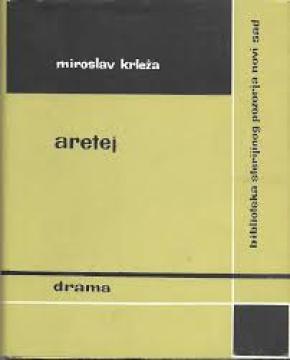
Aretej: drama

Krleža's drama with an extensive afterword by Branko Hećimović, biobibliographic contributions by Slavko Batušić and photos of scenes from "Areteja" performed by the National Theater, Belgrade.
In the play Aretêj, Miroslav Krleža creates a powerful portrait of the doctor Aretêj of Cappadocia, a man who, despite the chaos of the world around him, stubbornly adheres to an ethical principle: to save a person, regardless of their class, religion or political affiliation. The action is set in the late Roman Empire, during the persecution of Christians, social turmoil and moral decay. It is this historical framework that serves Krleža as a mirror of modernity — a dramatic portrayal of a man who remains committed to knowledge and humanity while the world surrenders to hatred and irrationality.
Aretêj finds himself between two fires: the Roman authorities, cruel and pragmatic, and the Christian communities that, although persecuted, show their own intolerance. His desire to help everyone brings him into conflict with both. At the heart of the play is his belief that a person is valuable for the very fact that he is a person, and not for belonging to a group. This is why the systems of power see him as a threat.
In Aretei, Krleža combines lyricism and thought: in his monologues one can feel the weariness of a man who sees the decline of values, but also the firm conviction that “a doctor must never stop healing”. The fate of the sick, wounded and rejected is depicted in dramatic scenes, and Aretei among them remains the last point of humanity.
Aretei is at the same time a historical picture and a philosophical drama, one of the highlights of Krleža's tragic literature. Through the fate of an individual who does not agree to hatred and ideological blindness, Krleža builds a universal story about resistance, moral responsibility and the price paid by a man who refuses to give up on good.
One copy is available