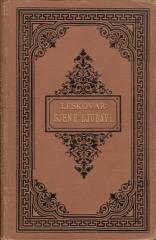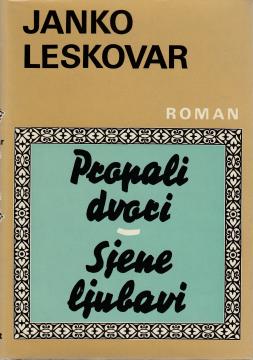
Propali dvori / Sjene ljubavi

Propali dvori / Sjene ljubavi

Janko Leskovar

"Propali dvori" is a novel by Janko Leskovar, published in 1896, which deals with deep psychological analyzes of the characters, emphasizing internal conflicts and feelings of disharmony with the outside world.

The action takes place in the surroundings of a ruined noble estate, which symbolizes decadence and the decay of former wealth. The main character, Fabijan Knezović, is a young man of humble origin, but highly educated and idealistic. Fabijan comes to the estate of the Kamiločević family, which is on the verge of financial ruin.

The family consists of the elderly Kamiločević, whose energy is spent, and his daughter Laura, a young but depressed woman, burdened by the burden of the family's past and social expectations. Fabijan falls in love with Laura, but that love is doomed in advance because of Laura's melancholy, which prevents her from finding happiness or a way out of her own psychological darkness.

Fabijan tries to help his family and restore the estate, believing in the power of work and will. However, faced with Laura's emotional coldness and his own growing doubts about the possibility of change, he eventually gives up on his attempts. Laura remains imprisoned in her suffering, and Fabijan leaves, deeply disappointed.

Maße
20 x 14 cm
Seitenzahl
263
Verlag
Mladost, Zagreb, 1978.
 
Latein Schrift. Fester Einband mit Schutzumschlag.
Sprache: Kroatisch.

Angeboten wird ein Exemplar

Zustand:Ungebraucht
Zum Warenkorb hinzugefügt!
 

Interessieren Sie sich für ein anderes Buch? Sie können das Angebot über unsere Suchmaschine suchen und finden oder Bücher nach Kategorien durchsuchen.

Diese Titel könnten Sie auch interessieren

Ljubičice u srijedu

Ljubičice u srijedu

Andre Maurois

André Maurois, a French writer known for his psychological novels and biographies, explores themes of family relationships, love, and internal conflicts in this work, which is characteristic of his style.

Svjetlost, 1965.
Kroatisch. Latein Schrift. Taschenbuch.
3,42 - 3,62
Stotina godina (antikronika)

Stotina godina (antikronika)

Dario Harjaček

The novel One Hundred Years by Dario Harjaček provides a panoramic view of Trešnjevka and its inhabitants through a century of changes, ideologies, and human destinies – a mosaic of Zagreb in which life, art, and history intertwine.

Oceanmore, 2025.
Kroatisch. Latein Schrift. Taschenbuch.
13,42
I ne reče ni reči

I ne reče ni reči

Heinrich Böll

In Boll's novels, one of the central themes is the attempt to preserve basic moral values ​​in a time of terror, as well as in a period of material prosperity and corruption.

Svjetlost, 1965.
Serbisch. Latein Schrift. Taschenbuch.
3,22 - 3,98
Tri mušketira 1-2

Tri mušketira 1-2

Alexandre Dumas

Dumas' version of the story depicts the adventures of d'Artagnan and his friends from 1625 to 1628.

Epoha, 1966.
Kroatisch. Latein Schrift. Fester Einband mit Schutzumschlag.
Das Buch besteht aus zwei Bänden
9,48
Proces

Proces

Franz Kafka

Kafka wrote The Process between 1914 and 1915, published posthumously in 1925. The novel is unfinished but with an added final chapter by Max Brod. Edition with a foreword by B. Živojinović and an afterword by Walter Killi.

BIGZ, 1990.
Serbisch. Latein Schrift. Taschenbuch.
4,26
Zagrepčanka

Zagrepčanka

Branislav Glumac

Branislav Glumac published a novel without periods or commas in 1974, as the relentless stream of thought of a young rebel. Published in socialist Yugoslavia, the work caused a scandal with its openness and became a classic about generational rebellion.

IROS, 1986.
Kroatisch. Latein Schrift. Hardcover.
8,22 - 8,24