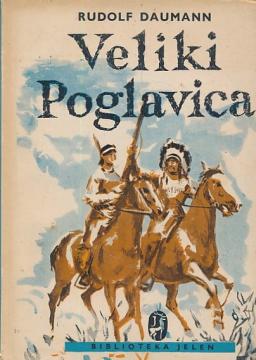
Veliki poglavica Tatanka-Yotanka: Roman o Sjedećem Biku, poglavici Siouxa

Veliki poglavica Tatanka-Yotanka: Roman o Sjedećem Biku, poglavici Siouxa

Rudolf Daumann

The novel Great Chief Tatanka-Yotanka by Rudolf Daumann tells the biographical story of the legendary Sioux chief, Sitting Bull (Tatanka Yotanka). The novel portrays Sitting Bull as a symbol of courage, resistance and dignity of indigenous peoples.

Through a historically based narrative, the novel follows his struggle to preserve the homeland, traditions and freedom of his people in the conflict with the American colonizers in the 19th century.

Sitting Bull, a charismatic leader and spiritual leader of the Lakota Sioux, led the resistance against the expansion of the American army and settlers into the Indian territories. His greatest victory occurred in 1876 at the Battle of the Little Bighorn, where the Sioux and their allies defeated General Custer and his army. But despite this triumph, the pressure from the white settlers and the army was increasing.

The novel also brings the personal side of the story - Sitting Bull was not only a warrior, but also a leader dedicated to his community. After years of resistance, he was forced to surrender to the American authorities and for a time stayed in a reservation. In the end, he was killed in 1890, on the eve of the bloody massacre at Wounded Knee, ending one of the most famous chapters in American Indian history.

Original title
Tatanka Yotanka
Translation
Oto Šolc
Editor
Grigor Vitez, Oto Šolc
Graphics design
Dalibor Parać
Dimensions
20 x 14 cm
Pages
330
Publisher
Mladost, Zagreb, 1958.
 
Latin alphabet. Paperback with dust jacket.
Language: Croatian.

No copies available

The last copy was sold recently.
 

Are you interested in another book? You can search the offer using our search engine or browse books by category.

You may also be interested in these titles

Sanjaj nemogući san

Sanjaj nemogući san

Johannes Mario Simmel

From the bestselling author of "Jimmy and the Rainbow," comes a novel that weaves a love story with the stirring events of the Bosnian war. This story, woven into the historical context, reminds us that sometimes the impossible dream is the only one worth

Mozaik knjiga, 1997.
Croatian. Latin alphabet. Hardcover.
7.42
Proces

Proces

Franz Kafka

Kafka wrote The Process between 1914 and 1915, published posthumously in 1925. The novel is unfinished but with an added final chapter by Max Brod. Edition with a foreword by B. Živojinović and an afterword by Walter Killi.

BIGZ, 1990.
Serbian. Latin alphabet. Paperback.
4.26
Noć

Noć

Edgar Hilsenrath

A poignant novel describing life in a Jewish ghetto in Ukraine, based on the author's experience as a Holocaust survivor. Set in the fictional town of Prokov, the novel follows the inhabitants of the ghetto, especially Raneko, as they struggle to survive.

August Cesarec, 1982.
Croatian. Latin alphabet. Hardcover with dust jacket.
6.584.94
Svi će ljudi biti braća

Svi će ljudi biti braća

Johannes Mario Simmel

The novel explores the moral dilemmas and social contradictions of post-war Europe. Through a tense crime story, the novel follows the protagonist as he faces personal and political challenges, revealing the complex relationships between the individual an

Mladost, 1984.
Croatian. Latin alphabet. Hardcover with dust jacket.
The book consists of two volumes
8.54
Čudovište iz predgrađa

Čudovište iz predgrađa

Franz Herwig

The novel The Monster from the Suburbs, published in 1936 by the Spiritual Youth Association in Senj, is a contemporary legend that explores the psychological and social aspects of life in urban suburbs.

Zbor duhovne mladeži, 1936.
Croatian. Latin alphabet. Paperback.
7.56
Hura, još živimo

Hura, još živimo

Johannes M. Simmel

The novel follows the life of Jakob Formann from 1946 to 1976: from a poor returnee from the war, through business ups and downs, love, marriages and scandals, to becoming one of the richest and most famous people in Germany.

Mladost, 1980.
Croatian. Latin alphabet. Hardcover with dust jacket.
6.485.18