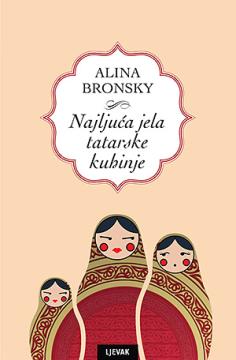
Najljuća jela tatarske kuhinje
Rare book

Najljuća jela tatarske kuhinje

Alina Bronsky

The main character, Rosa Ahmetovna, is an extremely self-centered, intrusive, tactless, sly and cunning narrator in this family saga by the author of the acclaimed novel "Scherbenpark" Alina Bronsky.

When Rosa Akhmetovna discovers that her seventeen-year-old daughter, "stupid Sulfia", is pregnant, and that the father of the child is unknown, she stops at nothing in an effort to induce an abortion, using various "folk recipes" for such cases.

But despite all her attempts, her plan backfired and Sulfija gave birth to a daughter, Aminat, in the Soviet Birth Center No. 134, who, to Rosa's great surprise and joy, is a "real Tatar" like her grandmother. While Rosa's husband Kalganov lazes in the park feeding pigeons and thinking about death, Rosa embarks on an epic battle to wrest Aminat away from Sulfia, whom she sees as a woefully incompetent mother.

When Aminat grows up a little and turns into a wild and self-willed teenager, she catches the eye of a sleazy German cookbook author who is researching Tatar cuisine, and Rosa uses his inappropriate affection for her underage granddaughter to make a deal with him that will allow the three women from the Ahmetov family to escape from the gloomy and difficult life in the Soviet Union.

But as soon as they find themselves in the West, the dysfunctional bonds that connect mother, daughter and granddaughter begin to crack.

Original title
Die schärfsten Gerichte der tatarischen Küche
Translation
Boris Perić
Editor
Nada Brnardić
Dimensions
20.5 x 13.5 cm
Pages
304
Publisher
Naklada Ljevak, Zagreb, 2014.
 
Latin alphabet. Paperback.
Language: Croatian.
ISBN
978-9-53303-699-1

One copy is available

Condition:Unused
 

Are you interested in another book? You can search the offer using our search engine or browse books by category.

You may also be interested in these titles

Zagrepčanka

Zagrepčanka

Branislav Glumac

Branislav Glumac published a novel without periods or commas in 1974, as the relentless stream of thought of a young rebel. Published in socialist Yugoslavia, the work caused a scandal with its openness and became a classic about generational rebellion.

IROS, 1986.
Croatian. Latin alphabet. Hardcover.
8.22 - 8.24
Proces

Proces

Franz Kafka

Kafka wrote The Process between 1914 and 1915, published posthumously in 1925. The novel is unfinished but with an added final chapter by Max Brod. Edition with a foreword by B. Živojinović and an afterword by Walter Killi.

BIGZ, 1990.
Serbian. Latin alphabet. Paperback.
4.26
Pariški maraton : Knjiga pisanja (Pariz21. i 22. oktobar 2023)

Pariški maraton : Knjiga pisanja (Pariz21. i 22. oktobar 2023)

At the end of the eighties, Damir Uzunović traveled to Paris and stayed there for less than a year. He was twenty years old at the time, and that exile episode would be formative for the literature he would later write.

Buybook, 2024.
Croatian. Latin alphabet. Hardcover.
12.22
Stotina godina (antikronika)

Stotina godina (antikronika)

Dario Harjaček

The novel One Hundred Years by Dario Harjaček provides a panoramic view of Trešnjevka and its inhabitants through a century of changes, ideologies, and human destinies – a mosaic of Zagreb in which life, art, and history intertwine.

Oceanmore, 2025.
Croatian. Latin alphabet. Paperback.
13.42
Dok ležah na samrti

Dok ležah na samrti

William Faulkner

Faulkner's 1930 novel, a classic example of modernist literature. It is often compared to Joyce's "Ulysses" for its innovative structure, but is more accessible due to its focus on family.

Rad, 1985.
Croatian. Latin alphabet. Paperback.
3.26
Glad na ledini

Glad na ledini

Agustin Stipčević
Zora, 1968.
Croatian. Latin alphabet. Hardcover with dust jacket.
5.22