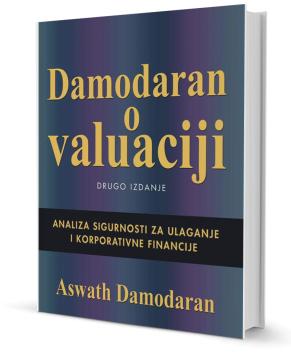
Damodaran o valuaciji

Damodaran o valuaciji

Aswath Damodaran

The ability to value assets is a key skill in a wide range of professional settings: from corporate finance to portfolio management and strategy.

While the reasons for valuation are as wide-ranging and varied as the business itself, the basic rules of valuation are surprisingly similar in both form and function. The second edition of Damodaran's book on valuation brings today the most direct and understandable overview of approaches and models for creating valuation. Written by noted professor, author and authority on valuation, Aswath Damodaran, and completely revised and updated from the hugely popular first edition - which has become an essential reference for any professional who needs accurate and reliable valuation information - this invaluable book brings you: • Thorough coverage of various distinctive valuation approaches and the key models within each • Techniques for properly estimating the effect on the value of employee stock options and other stock-based compensation • Methodologies for the use of evaluation models for intangible assets - patents, copyrights, trademarks, licenses, trademarks, etc. • Sound strategies for identifying and measuring the value of control in a business and why the expected value of control plays a role in many different valuation contexts. • A discussion of the impact of liquidity - or, more accurately, illiquidity - on value, as well as ways to measure that impact • Potential sources of elusive "synergies" when merging two entities, how best to evaluate each type of synergy, and an exploration of why companies so often overpay for synergies

Original title
Damodaran on valuation
Translation
Iva Cerovsky
Dimensions
25 x 18.5 cm
Pages
688
Publisher
Mate d.o.o, Zagreb, 2010.
 
Latin alphabet. Hardcover.
Language: Croatian.
ISBN
978-9-53246-087-2

No copies available

The last copy was sold recently.

 

Are you interested in another book? You can search the offer using our search engine or browse books by category.

You may also be interested in these titles

Kraj siromaštva: Ekonomske mogućnosti našeg doba

Kraj siromaštva: Ekonomske mogućnosti našeg doba

Jeffrey Sachs

In the book, economist Jeffrey Sachs presents an optimistic plan for eliminating extreme poverty by 2025. He argues that this is feasible with political will, because world wealth is growing, and poverty is not fate, but the result of inefficient systems.

Algoritam, 2007.
Croatian. Latin alphabet. Paperback.
9.78
Der deutsche Geschäftsbrief / Njemačko poslovno dopisivanje

Der deutsche Geschäftsbrief / Njemačko poslovno dopisivanje

Blanka Jakić

"German Business Correspondence" by Blanka Jakić is a textbook intended for students, business people and anyone who wants to master business communication skills in German.

Školska knjiga, 1971.
Croatian. Latin alphabet. Hardcover.
7.32
Klasna borba i koncepcije razvoja

Klasna borba i koncepcije razvoja

Luka Marković

Diese Arbeit befasst sich mit den Themen Klassenkampf und unterschiedlichen Vorstellungen von sozialer und wirtschaftlicher Entwicklung und bietet Einblicke in für die damalige Zeit relevante soziologische und wirtschaftliche Theorien.

Naprijed, 1978.
Croatian. Latin alphabet. Hardcover.
5.98
Zur Kritik bürgerlicher Didaktik und Bildungsökonomie

Zur Kritik bürgerlicher Didaktik und Bildungsökonomie

Freerk Huisken
List Verlag München, 1972.
German. Latin alphabet. Paperback.
3.98
Englesko-hrvatski ekonomski rječnik / Hrvatsko-engleski ekonomski rječnik

Englesko-hrvatski ekonomski rječnik / Hrvatsko-engleski ekonomski rječnik

Ante Babić

Novo, dopunjeno i ažurirano izdanje englesko-hrvatskog i hrvatsko-engleskog poslovnog rječnika u dva toma vrijedno je poslovnim ljudima, u vrijeme gotovo svakodnevnog pojavljivanja novih ekonomskih pojmova koji prate brojne promjene u teoriji i praksi pos

Mate d.o.o, 2009.
Croatian. Latin alphabet. Hardcover.
The book consists of two volumes
24.36 - 56.38
Rat protiv gladi

Rat protiv gladi

Vladimir Paleček

"War on Hunger" by Vladimir Paleček, published in 1979, is a literary work that explores the causes and consequences of global hunger and proposes possible solutions to this serious problem.

Međunarodni fond '' Gladno dijete '', 1979.
Croatian. Latin alphabet. Paperback.
4.82