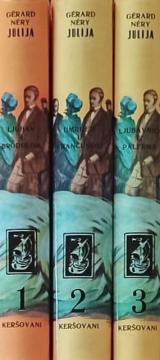
Julija 1-3

Julija 1-3

Gérard Néry

The novel's plot is set within the framework of historical events of the second half of the 19th century, intertwined with a love story and adventures of the young, underage, and madly in love Juliet, who nevertheless experiences her passions in a mature

Juliet has no parents, but she is rich, and her protector, the famous Parisian financier Gaspard, takes care of her money and upbringing. This beautiful and lovely girl moves in the most elegant circles of the French capital, is seen at the court of Emperor Napoleon III, has every chance of marrying richly and becoming a member of the Parisian social elite...

But love changes the course of her life. She falls in love with the young and handsome officer Alain Delatouche, who is very ambitious and wants to make a great career for himself, which is why he sets off for Mexico with the expeditionary corps that Napoleon III sends to help Maximilian.

Juliet breaks up with Alain. She is devastated by the sudden end of her newly begun love, and decides to remain faithful to her pain and unfulfilled love. After some time, this love burns even stronger in the beautiful heroine when she learns that her chosen one has disappeared in the fighting with the rebels in Mexico and is probably captured. The beautiful Julia decides to go to Mexico, in search of Alain. And so begins her great adventure…

After secretly preparing to escape. Julia boards a ship for Mexico. On board, she meets a young journalist, Raoul. Their acquaintance soon turns into love… However, the journey promises no happiness; the ship is damaged by a storm, and then destroyed by the explosion of ammunition intended for the French army in Mexico. Only Julia is miraculously saved and finally arrives in New York on the deck of an English warship.

In Paris, they learn of her escape, the shipwreck, and later of Julia's rescue. Her protector informs the French consul, who is supposed to meet her in New York. But Julia eludes him...

Original title
Julie Crèvecoeur
Translation
Ivo Bakotić
Dimensions
20 x 12 cm
Pages total
1101
Publisher
Otokar Keršovani, Rijeka, 1973.
 
Latin alphabet. Hardcover with dust jacket.
Language: Croatian.

The book consists of 3 volumes.

Jedan višetomni primjerak je u ponudi.
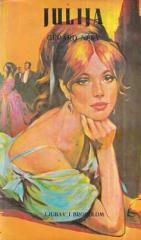
Julija 1-3
Volume 1
Pages: 359
Condition:Used, excellent condition
Julija 1-3
Volume 2
Pages: 413
Condition:Used, excellent condition
Julija 1-3
Volume 3
Pages: 329
Condition:Used, very good condition
 

Are you interested in another book? You can search the offer using our search engine or browse books by category.

You may also be interested in these titles

Štefica Cvek u raljama života

Štefica Cvek u raljama života

Dubravka Ugrešić

Do you like "lovelies"? Whatever you think about them, you'll enjoy this superb pastiche of trivial romance novels.

Mladinska knjiga, 1990.
Croatian. Latin alphabet. Hardcover with dust jacket.
4.94
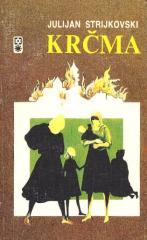
Krčma

Krčma

Julian Stryjkowski

The book "Inn" by Julian Stryjkowski, published in 1977, explores life in a small Jewish village in Galicia during the 19th century.

BIGZ, 1977.
Serbian. Latin alphabet. Paperback.
4.38
Deobe 1-3

Deobe 1-3

Dobrica Ćosić

This work, awarded the NIN Prize for that year, is considered one of the most significant in Serbian literature after World War II.

Prosveta, 1961.
Serbian. Cyrillic alphabet. Hardcover with dust jacket.
The book consists of 3 volumes
11.42
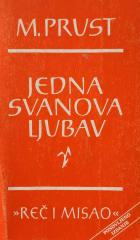
Jedna Svanova ljubav

Jedna Svanova ljubav

Marcel Proust
Rad, 1984.
Serbian. Latin alphabet. Paperback.
2.98
Usta puna zemlje

Usta puna zemlje

Branimir Šćepanović

The novel "Usta puna zemlje" (1970), the masterpiece of the Serbian writer Branimir Šćepanović, is a psychologically in-depth explorer of the limits of the human soul, solitude and existential freedom, reminiscent of Kafka and Camus.

BIGZ, 1987.
Serbian. Latin alphabet. Paperback.
3.98
Bilješka o piscu: Neljubavni roman

Bilješka o piscu: Neljubavni roman

Julijana Matanović

A Writer's Note is the first bestseller by beloved Croatian author Julijana Matanović. A hit since its publication, the novel reminds us that the past cannot be erased, only understood.

Mozaik knjiga, 2002.
Croatian. Latin alphabet. Paperback.
6.36 - 6.38